How to set up a UK office from abroad? A step-by-step guide for efficient office setup
If you’re planning to set up a UK office from abroad, finding a workspace is only one part of the process. You’ll also need to decide which office model suits your business, choose the right location, understand occupancy costs, and coordinate much of the process remotely. This guide explains each step in detail, helping you make informed decisions and avoid costly mistakes when establishing your UK office.
Can a foreign company open an office in the UK?
Yes, a foreign (overseas) company can open an office in the UK. According to the official UK Government (GOV.UK) guidelines, foreign businesses typically expand into the UK using one of two primary corporate structures:
Register a UK Branch / UK Establishment
If you want your existing foreign business to register as an overseas company and to operate directly in the UK without creating a new, separate legal entity, you can register a UK Establishment (often referred to as a branch or representative office).
- Key Detail: The parent company remains fully liable for all UK activities, debts, and legal obligations.
- How to Register: You must register with Companies House (the UK’s registrar of companies) within one month of opening for business.
- What’s Required: You must submit Form OS IN01 along with a registration fee (currently £124 as of 2026). You will also need to submit certified, English-translated copies of your parent company’s constitutional documents and latest financial accounts. All directors must also undergo mandatory identity verification.
Set Up a UK Subsidiary
If you want to create a brand-new, independent corporate structure, you can incorporate a UK Subsidiary (typically a Private Limited Company or “Ltd”).
- Key Detail: The subsidiary is a separate legal entity. This means the foreign parent company is generally protected from the UK office’s liabilities and debts.
- How to Register: You register online directly through Companies House. Setting up a subsidiary is usually much faster than registering a branch (often completed within 24 hours).
For a full breakdown of the legal requirements for setting up a business in London, you can refer to our guide for opening a company to find out more about the detailed legal process. With the legal foundation in place, let’s move on to the practical steps of finding and launching your physical office.
Step 1: Choose the right type of office
The type of workspace you choose affects your costs, flexibility and how quickly you can begin operating. Before viewing properties, determine which office model best matches your business objectives.
Serviced offices
Serviced offices are often the fastest option for overseas businesses entering the UK market.
These offices are fully furnished and typically include:
- Utilities
- High-speed internet
- Reception services
- Cleaning and maintenance
- Meeting room access
- Business lounges
- Flexible licence agreements
Because the workspace is already operational, your team can often move in within days rather than months.
Serviced offices are well suited to:
- Businesses testing the UK market
- Small regional teams
- Start-ups
- Companies expecting rapid growth
- Organisations that prioritise flexibility
The trade-off is that branding opportunities and office customisation are usually limited compared with leased offices.
Managed offices
Managed offices provide a balance between flexibility and customisation.
Unlike serviced offices, these spaces can often be tailored to reflect your company’s branding, workplace culture and operational needs, while the landlord or operator continues to manage many day-to-day building services.
This option works well for businesses that:
- Require a branded office
- Plan to grow over the next few years
- Want predictable occupancy costs
- Prefer not to manage facilities internally
Traditional leased offices
A conventional lease offers the greatest level of control but also requires the highest level of planning.
With a traditional office, you’ll normally be responsible for:
- Interior fit-out
- Furniture procurement
- IT infrastructure
- Utilities
- Cleaning contracts
- Repairs and maintenance (depending on lease terms)
- Office management
While this approach generally offers lower occupancy costs over a longer period, it involves greater upfront investment and longer lease commitments. It is often the preferred option for established businesses opening a permanent UK headquarters. To see furthe details of these three types of office, you can read our article about comparing serviced-managed-leased offices to gain more insights to make better decision.
Step 2: Choose the right location
Where you establish your office will influence recruitment, client accessibility, operating costs and your company’s market positioning.
Rather than focusing solely on rental costs, evaluate how each location supports your business objectives.
Match your location to your industry
Different parts of London have developed strong reputations for particular sectors.
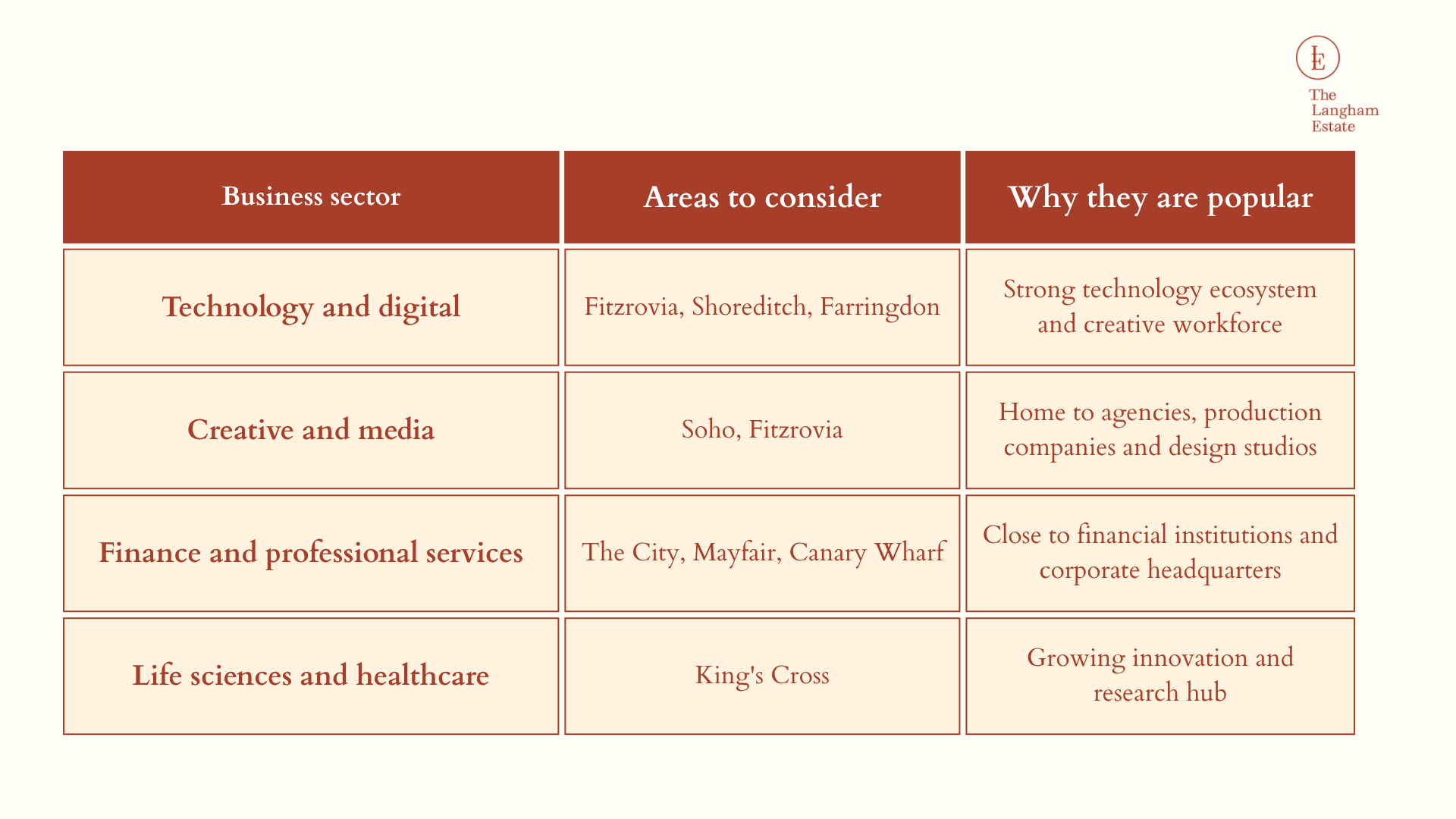
International businesses should align their office address with London’s distinct industry clusters. London operates on a system of “sector gravity”—positioning your company in the correct neighborhood instantly boosts your local credibility, simplifies recruitment by putting you near a highly specialized talent pool, and places you within walking distance of key clients and partners.
While financial institutions remain anchored to high-security hubs like the City and Mayfair, creative and technology-driven businesses have a unique advantage in areas like Fitzrovia, which serves as a rare “overlap zone” bridging both creative media and cutting-edge tech ecosystems.
Consider other UK cities
Depending on your industry, another UK city may provide better value while still offering excellent business infrastructure.
For example:
- Manchester has a thriving digital, media and technology sector.
- Birmingham is a leading centre for legal, financial and professional services.
- Bristol is recognised for aerospace, engineering and sustainability-focused businesses.
- Edinburgh combines a strong financial services sector with an increasingly active technology community.
For businesses whose employees rarely need to meet London-based clients, these cities may provide a lower overall occupancy cost.
Step 3: Define your office requirements
Before arranging viewings, prepare a clear list of operational requirements.
This ensures every property you consider is assessed against the same criteria.
Estimate your space requirements
Consider not only your current team but also expected growth over the next three to five years.
Questions to consider include:
- How many employees will be office-based?
- Will overseas staff relocate to the UK?
- Will hybrid working reduce desk requirements?
- Will client meetings be held on-site?
- Will additional departments be added in the future?
Choosing an office that supports future expansion can reduce the cost and disruption of relocating after only a short period.
Identify essential workplace features
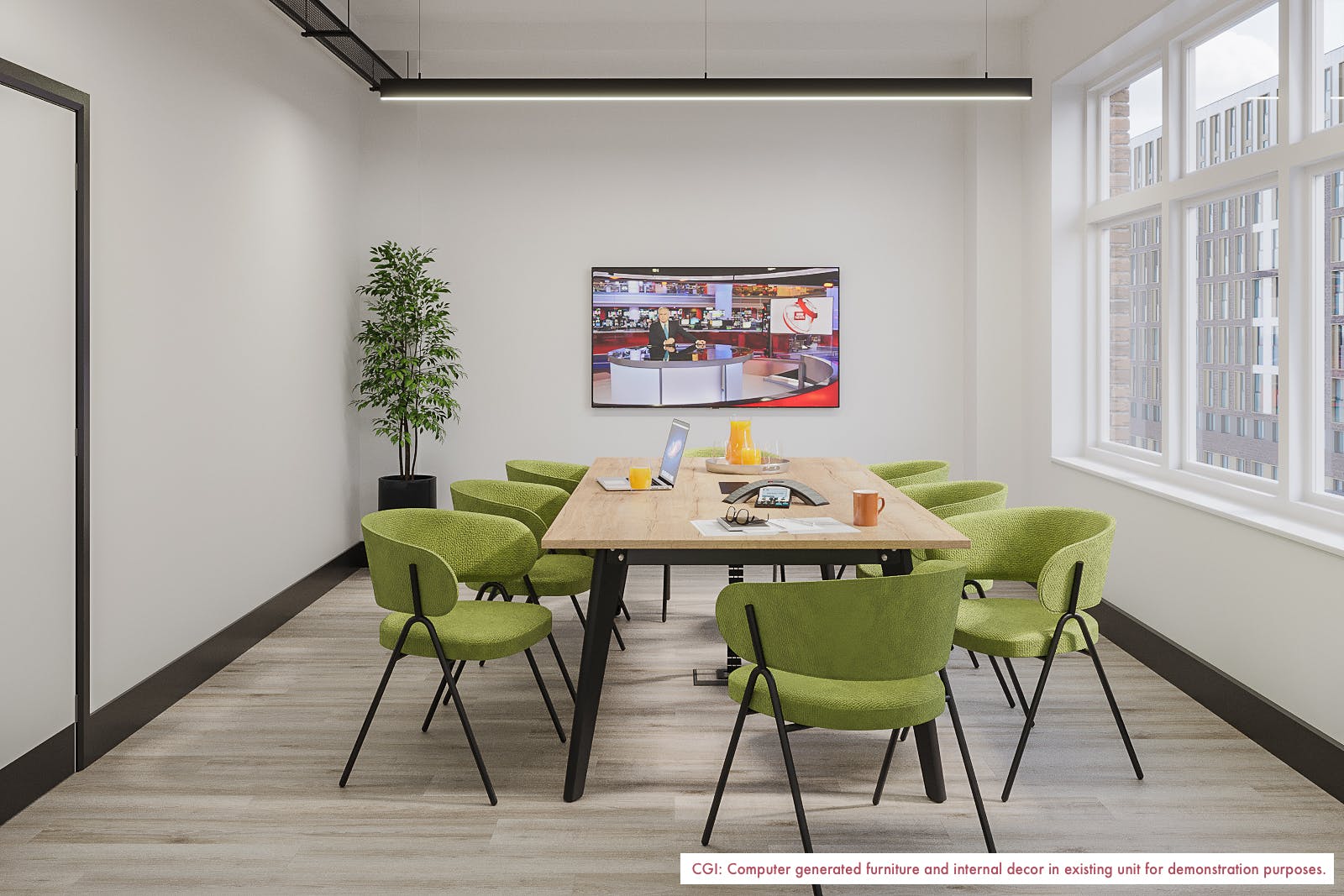
Every business has different operational priorities.
Common requirements include:
- Meeting rooms
- Private offices
- Collaboration spaces
- High-speed internet
- Secure access
- Air conditioning
- Bicycle storage
- Showers
- Accessibility features
- 24-hour building access
Prioritising these requirements before beginning your search makes it easier to compare properties objectively.
Separate essential requirements from preferences
Not every attractive feature is essential.
Create two lists.
Essential requirements
- Convenient transport links
- Reliable connectivity
- Appropriate office size
- Security
- Meeting facilities
Preferred features
- Roof terrace
- Gym
- On-site café
- Wellness facilities
- Event spaces
This approach helps avoid paying for amenities that add little value to your day-to-day operations.
Choosing the right office type, location and budget creates a solid foundation for your UK expansion. Once these decisions have been made, the next stage is evaluating available properties, carrying out remote viewings and selecting a workspace that aligns with both your operational needs and long-term business goals.
Step 4: Set a realistic budget
Rental costs represent only a fraction of the total investment required to establish a UK workspace. Before beginning your property search, calculating the Total Cost of Occupancy (TCO) is essential to avoid unexpected cash flow strain.
Estimated London market prices
London’s property market is priced differently depending on the workspace model you choose. To set a realistic budget, you must understand the current 2026 market baselines:
- Coworking Spaces (Shared / Open Plan): Best for small teams or soft-launches. Hot desks generally range from £250 to £500 per month, while a dedicated desk averages £500 to £800+ per month in prime central locations.
- Serviced Offices (Private Flex Space): Best for teams of 5 to 50 who want an all-inclusive, plug-and-play monthly bill. The central London median sits at £675 to £678 per desk, per month. However, premium business districts like Mayfair, Soho, or the City Core can command £700 to £950+ per desk.
- Traditional Leases (Conventional Space): Best for larger, established teams. These are priced per square foot per year. Central London’s prime rents vary dramatically by neighborhood, with the West End (Mayfair/St. James’s) commanding super-prime rates of £100 to £250+ per sq ft, the City Core averaging £100 to £150+ per sq ft.
To gain more office rental pricing in London, you can see more detailed information in our blog answering your consideration about cost to rent office space in London
Calculating the full cost of occupancy
A common mistake for overseas companies is comparing properties by headline rent alone. The true cost of renting a traditional office is typically double the base rent once you factor in the full occupancy costs:
- Up-front outlays: Budget for a security deposit (typically 3 to 6 months’ rent for international businesses), legal fees for lease negotiation, IT infrastructure, and furniture or cosmetic design (“fit-out”) costs.
- Business rates: This is a mandatory local property tax collected by the government. In prime London locations, business rates alone can add an extra 30% to 50% on top of your annual base rent.
- Service charges & utilities: On a traditional lease, you must pay your share of building maintenance, elevators, and security (service charges), alongside electricity, water, and dedicated fiber internet.
- Dilapidations: A unique quirk of the UK market. When your lease ends, you are legally required to pay to restore the office exactly to its original, pre-move-in condition.
- Currency buffer: For overseas parent companies, exchange rate fluctuations are a hidden risk. Factor a 5–10% volatility buffer into your financial planning if your local revenues are in a foreign currency but rent is billed in British Pounds (GBP).
Step 5: Research office spaces and shortlist suitable properties
Once you’ve defined your requirements, it’s time to begin evaluating available office space. At this stage, efficiency is important—especially if you’re managing the process from another country. Rather than contacting every landlord or arranging multiple overseas trips, develop a structured approach to comparing properties.
Start with reliable commercial property listings
Commercial property websites are useful for understanding what’s available in your target area, but don’t rely on photographs alone. High-quality listings should provide information that helps you assess whether a property is genuinely suitable before arranging a viewing.
Look for details such as:
- Net internal floor area
- Floor plans
- EPC rating
- Lease terms
- Available date
- Building amenities
- Nearby transport links
- Whether the office is fitted, furnished or offered in Cat A condition
Floor plans are particularly valuable because they allow you to assess how efficiently the space can accommodate your team. Two offices with the same square footage can support very different workplace layouts.
Compare properties using consistent criteria
Creating a comparison table with clear criteria can help you make objective decisions rather than relying on first impressions. Using the same criteria across every property makes comparisons much more meaningful.
Consider scoring each property against factors such as:
- Location: Is it convenient for employees and clients?
- Office layout: Does it support your preferred way of working?
- Cost: Does the total occupancy cost fit your budget?
- Lease flexibility: Can the space grow with your business?
- Building quality: Is the property well-maintained and professionally managed?
- Amenities: Are meeting rooms, cafés, and fitness facilities nearby?
- Connectivity: Is there reliable broadband and strong mobile coverage?
Step 6: Arrange virtual office viewings
One of the biggest advantages for international businesses today is that many initial property viewings can be completed remotely.
Virtual tours help narrow your shortlist before investing time and money in travelling to the UK.
Ask for a live walkthrough instead of a recorded video
A pre-recorded marketing video usually highlights only the best parts of a building. A live video viewing gives you the opportunity to ask questions and inspect areas that may affect day-to-day operations.
During a live viewing, ask the agent to show:
- The entrance and reception
- Lift access
- Common areas
- Washrooms
- Kitchen facilities
- Meeting rooms
- Windows and natural light
- Ceiling height
- Views from the office
- Building surroundings
This provides a much more realistic impression than professional marketing photography.
Ask practical operational questions
A virtual viewing is also an opportunity to clarify details that may not appear in the brochure.
Useful questions include:
- What internet providers are available?
- Are there any planned building refurbishments?
- What are the building access hours?
- Are visitors required to check in?
- Is cycle storage available?
- Are shower facilities included?
- What additional service charges should be expected?
- How quickly could the office be occupied?
Obtaining clear answers early reduces the risk of surprises during lease negotiations.
Step 7: Negotiate the best lease terms
Once you’ve identified the right office, the next step is negotiating commercial terms. For businesses setting up a UK office from abroad, this stage is particularly important because lease agreements can affect both your short-term costs and your ability to grow in the future.
Rather than focusing solely on the headline rent, consider the overall value of the agreement. A slightly higher rent may be worthwhile if it includes a rent-free period, landlord contributions towards fit-out costs or more flexible lease terms.
Know what can be negotiated
Many international businesses assume commercial lease terms are fixed. In reality, landlords are often willing to negotiate, particularly if you’re committing to a longer lease or occupying a larger space.
Areas that may be negotiable include:
- Rent-free periods before occupation
- Lease length
- Break options
- Deposit requirements
- Landlord contributions towards fit-out
- Permission to install branding or specialist equipment
- Flexible expansion opportunities within the same building
If you’re unfamiliar with the UK commercial property market, working with an experienced commercial property adviser or solicitor can help you understand whether the proposed terms are competitive.
Look beyond today’s requirements
When expanding internationally, business needs can change quickly. Before signing a lease, consider how the agreement will support your company over the next three to five years.
Questions worth asking include:
- Can additional space be leased within the same building if the team grows?
- Is it possible to downsize if business priorities change?
- Are there restrictions on assigning or subletting the lease?
- How much notice is required if you wish to leave?
Choosing a lease with sufficient flexibility can reduce relocation costs as your UK operation evolves.
Step 8: Complete the legal process
After agreeing commercial terms, solicitors for both parties will prepare the lease documentation. Although much of this process can be completed remotely, overseas companies should allow sufficient time for legal checks before committing to the agreement.
Carry out due diligence
Before signing, ensure you understand both the property and the obligations contained within the lease.
Areas to review include:
- The exact floor area being leased
- Repair and maintenance responsibilities
- Service charge arrangements
- Building insurance provisions
- Access rights and operating hours
- Restrictions on alterations or signage
- Energy performance information
- Health and safety responsibilities
If anything is unclear, seek legal advice before signing rather than relying on verbal assurances.
Prepare the necessary documentation
Landlords may request documentation to confirm your company’s identity and financial standing.
Depending on your circumstances, this may include:
- Company registration documents
- Proof of directors’ identity
- Financial statements
- Business references
- Bank references
- Parent company guarantees or rent deposits for newly established businesses
Providing these documents promptly can help avoid unnecessary delays.
Complete the process remotely
Many commercial leases can now be completed without travelling to the UK.
Digital signing platforms allow agreements to be executed securely, while deposits and initial rent payments can usually be transferred electronically.
Once the lease has completed, you’ll receive confirmation of your occupation date, allowing preparations for the move to begin.
Step 9: Prepare your office before moving in
Signing the lease is only the beginning. Careful planning before your team arrives will help ensure operations start smoothly from day one.
Set up essential infrastructure
Before occupation, confirm that all operational systems are ready.
This typically includes:
- Internet installation
- Telephone systems
- Wi-Fi configuration
- IT equipment
- Printers
- Access control systems
- Meeting room technology
- Cybersecurity measures
Testing these systems before employees move in helps minimise disruption during the first weeks of operation.
Meet compliance requirements
Depending on your office type, some compliance responsibilities may sit with the landlord while others remain with the tenant.
Common considerations include:
- Employers’ liability insurance
- Public liability insurance
- Fire safety procedures
- Health and safety policies
- Display screen equipment assessments
- Workplace risk assessments
Understanding these responsibilities early will help ensure your new office complies with UK regulations.
Create a workplace that reflects your business

A well-designed office supports both employee wellbeing and client experience.
Even where major alterations aren’t possible, businesses can personalise their workspace through:
- Company branding
- Artwork
- Plants
- Meeting room design
- Breakout areas
- Collaborative workspaces
For managed and leased offices, there may be greater opportunities to tailor the layout to your operational requirements and company culture.
Help employees settle into the new office
If employees are relocating from overseas, consider how you’ll support them during the transition.
Practical measures include:
- Office orientation sessions
- Access cards and security training
- Information about local transport
- Recommendations for nearby cafés and restaurants
- Guidance on healthcare and other local services
- Introductions to colleagues and neighbouring businesses
A thoughtful onboarding process helps employees become productive more quickly while creating a positive first impression of the new workplace.
Helpful tips to set up a UK office from abroad successfully
Create a shortlist before visiting the UK
After reviewing multiple properties, reduce your options to a manageable shortlist. For most overseas businesses, visiting three to five offices in person is considerably more practical than viewing dozens.
Shortlisting should consider not only the office itself but also the surrounding neighbourhood, long-term suitability and lease flexibility. If several properties appear similar, prioritise those that best support your future business plans rather than simply choosing the lowest rent.
Try your best visiting your shortlisted offices in person
Although much of the leasing process can be completed remotely, an in-person visit remains one of the most valuable stages before signing an agreement. Walking through a building often reveals details that cannot be fully appreciated online.
Assess the office beyond the marketing materials
During your visit, pay attention to factors such as:
- Noise levels inside the building
- Natural daylight throughout the workspace
- Quality of communal areas
- Lift waiting times
- General building maintenance
- Security arrangements
- Air conditioning performance
- Overall atmosphere
An office may appear attractive online but feel very different during a typical working day.
Explore the surrounding neighbourhood
Your employees and clients won’t only experience the office—they’ll experience its location.
Spend time exploring the surrounding streets and ask questions such as:
- Are there cafés suitable for informal meetings?
- Are there restaurants within walking distance?
- Is public transport genuinely convenient?
- Are nearby streets busy during commuting hours?
- Does the area feel safe during the evening?
- Are there hotels nearby for visiting colleagues?
These practical considerations have a direct impact on employee experience and client perception.
Why Fitzrovia is an ideal location for international businesses
A strategic Central London location
- Prime Central London location: Situated in the heart of the West End, Fitzrovia is bordered by Oxford Street, Regent Street, and Marylebone. This positioning gives your business immediate prestige and effortless access to both the West End’s retail district and the City’s financial hub.
- Rapid airport access: Nearby Tottenham Court Road station connects directly to the high-speed Elizabeth line, allowing employees and international clients to travel to and from Heathrow Airport in under 40 minutes.
- A thriving business ecosystem: Establishing an office here places you alongside an established, diverse community of world-class technology innovators, creative agencies, professional services, healthcare institutions, and major international brands.
Choosing the right neighbourhood is just as important as selecting the right office. Businesses often look for a location that balances accessibility, professional credibility and an environment where employees enjoy spending time.
Fitzrovia has become one of Central London’s most sought-after commercial districts because it brings these qualities together.
How The Langham Estate Supports Your UK Expansion
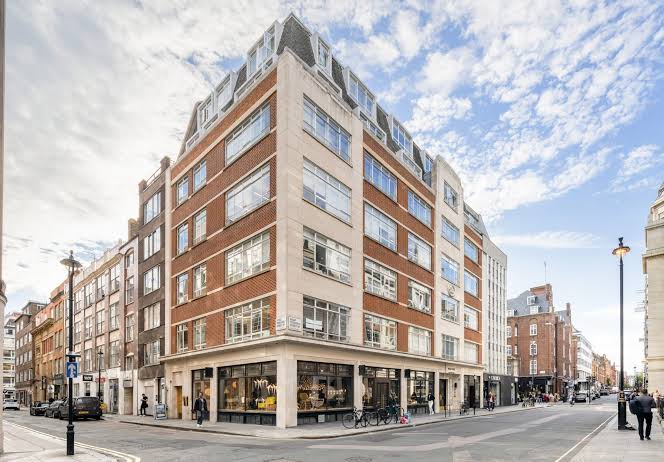
For international companies establishing their first UK office, partnering with a landlord that understands both the local market and the long-term evolution of the neighbourhood is critical. The Langham Estate makes your physical search straightforward and highly structured:
- Unmatched Local Expertise: With nearly a century of history in the West End, The Langham Estate focuses exclusively on Fitzrovia. Rather than managing properties across scattered locations, this deep concentration gives you the benefit of dedicated property management and local insight.
- Flexible Lease Options: Recognizing that international businesses have varying growth speeds, the Estate offers highly adaptable occupational arrangements—ranging from traditional corporate leases to flexible, fully fitted “plug-and-play” suites.
Prime office spaces available now:
- 2nd Floor Front, 75–77 Margaret Street: A well-positioned, characterful office located just moments from Oxford Circus, perfect for businesses seeking a highly prestigious West End address.
- 4th Floor, 6–10 Great Portland Street: A contemporary, newly refurbished office layout offering exceptional natural light and premium transport connectivity—ideal for growing teams.
- Ground Floor, 21 Great Titchfield Street: A prominent, highly visible workspace designed for convenient client access in one of Central London’s most established commercial corridors.
Working with a dedicated, local landlord provides your business with operational confidence long after the initial lease transaction is signed. Contact us now for a helpful and free consultation to find the right physical footprint for your business.
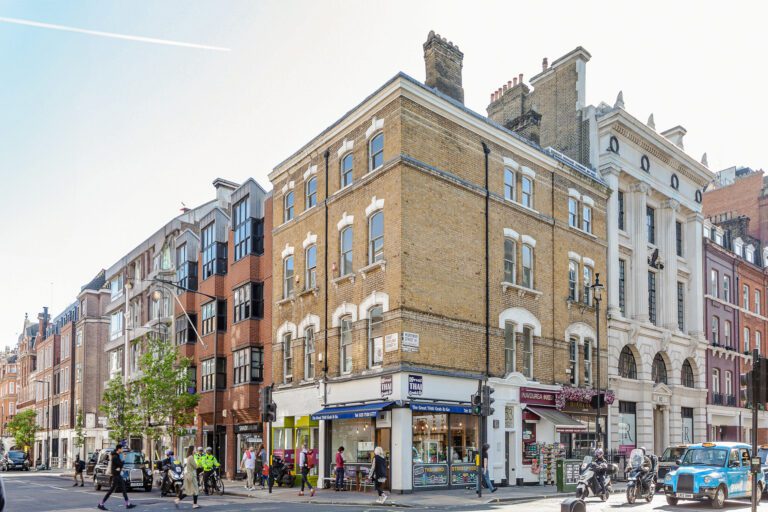
Central London continues to attract international businesses
Successfully setting up a UK office from abroad involves much more than signing a lease. Choosing the right office model, selecting a location that supports your business objectives, understanding the full cost of occupation and planning for future growth all contribute to a smoother expansion.
For businesses looking to establish a presence in Central London, Fitzrovia continues to stand out for its connectivity, diverse business community and vibrant commercial environment. With a carefully curated portfolio of office spaces and decades of stewardship in the neighbourhood, The Langham Estate offers businesses the opportunity to become part of one of London’s most established and forward-looking commercial districts.
Successfully setting up a UK office from abroad involves much more than signing a lease. Choosing the right office model, selecting a location that supports your business objectives, understanding the full cost of occupation and planning for future growth all contribute to a smoother expansion.
For businesses looking to establish a presence in Central London, Fitzrovia continues to stand out for its connectivity, diverse business community and vibrant commercial environment. With a carefully curated portfolio of office spaces and decades of stewardship in the neighbourhood, The Langham Estate offers businesses the opportunity to become part of one of London’s most established and forward-looking commercial districts.
FAQs
Can I rent office space in the UK before moving there?
Yes. Many international businesses complete much of the leasing process remotely through virtual viewings, digital document signing and online communication with landlords, solicitors and advisers. However, if possible, visiting your shortlisted offices before signing a long-term lease is still recommended.
Do I need a UK company before leasing office space?
Not always. Some landlords will lease space to overseas companies, although they may request additional financial information, a larger rent deposit or a parent company guarantee. It’s worth discussing your corporate structure early in the process.
What type of office is best for businesses entering the UK market?
For many companies, serviced or managed offices offer the greatest flexibility because they require less upfront investment and can accommodate changing team sizes. Businesses planning a permanent UK headquarters may prefer a traditional lease for greater control over the workspace.
How long does it take to set up a UK office from abroad?
The timeline depends on the office type. A serviced office may be ready within days, whereas securing and fitting out a traditional leased office can take several months. Planning ahead and preparing documentation early can help avoid delays.
What should I look for during an office viewing?
Beyond the office itself, assess the building’s condition, natural light, internet connectivity, meeting facilities, accessibility, surrounding amenities and transport links. Also consider whether the space can accommodate future growth.
Is Central London worth the additional cost?
For many international businesses, yes. A Central London location can improve access to clients, talent and transport while enhancing your company’s professional image.