Best Central London office locations for law firms
London holds some of England’s main legal and commercial districts, including Chancery Lane, Holborn, Temple, the City of London, Mayfair and Fitzrovia. Having your legal office in or near these areas makes it easier for your team to reach courts, chambers and client meetings, while also providing convenient transport connections.
This guide compares the main legal office districts and explains which areas suit different practices, along with the transport, cost and workspace factors you should check before choosing an office.
Best London legal office districts at a glance
| Area | Suitable for | Main advantage |
|---|---|---|
| Fitzrovia | Growing firms and specialist practices | Central access without relying on a traditional legal postcode |
| Chancery Lane | Solicitors, litigation and dispute resolution | Close to the Law Society and established legal businesses |
| Holborn | Growing and mixed practice firms | Access to the legal quarter with several transport options |
| Temple and Fleet Street | Barristers and litigation teams | Close to Inner Temple, Middle Temple and the Royal Courts of Justice |
| City of London | Corporate, finance and commercial law | Close to banks and major corporate clients |
| Mayfair and St James’s | Private client, wealth and international practices | Close to West End clients and advisers |
| Canary Wharf | Banking and financial services law | Close to financial organisations based in Docklands |
1. Fitzrovia for growing and specialist law firms
Fitzrovia gives a law firm a Central London base without requiring it to sit directly inside the traditional legal quarter. The area can suit specialist practices and growing firms whose lawyers divide their time between the West End, Holborn and commercial clients elsewhere in Central London.
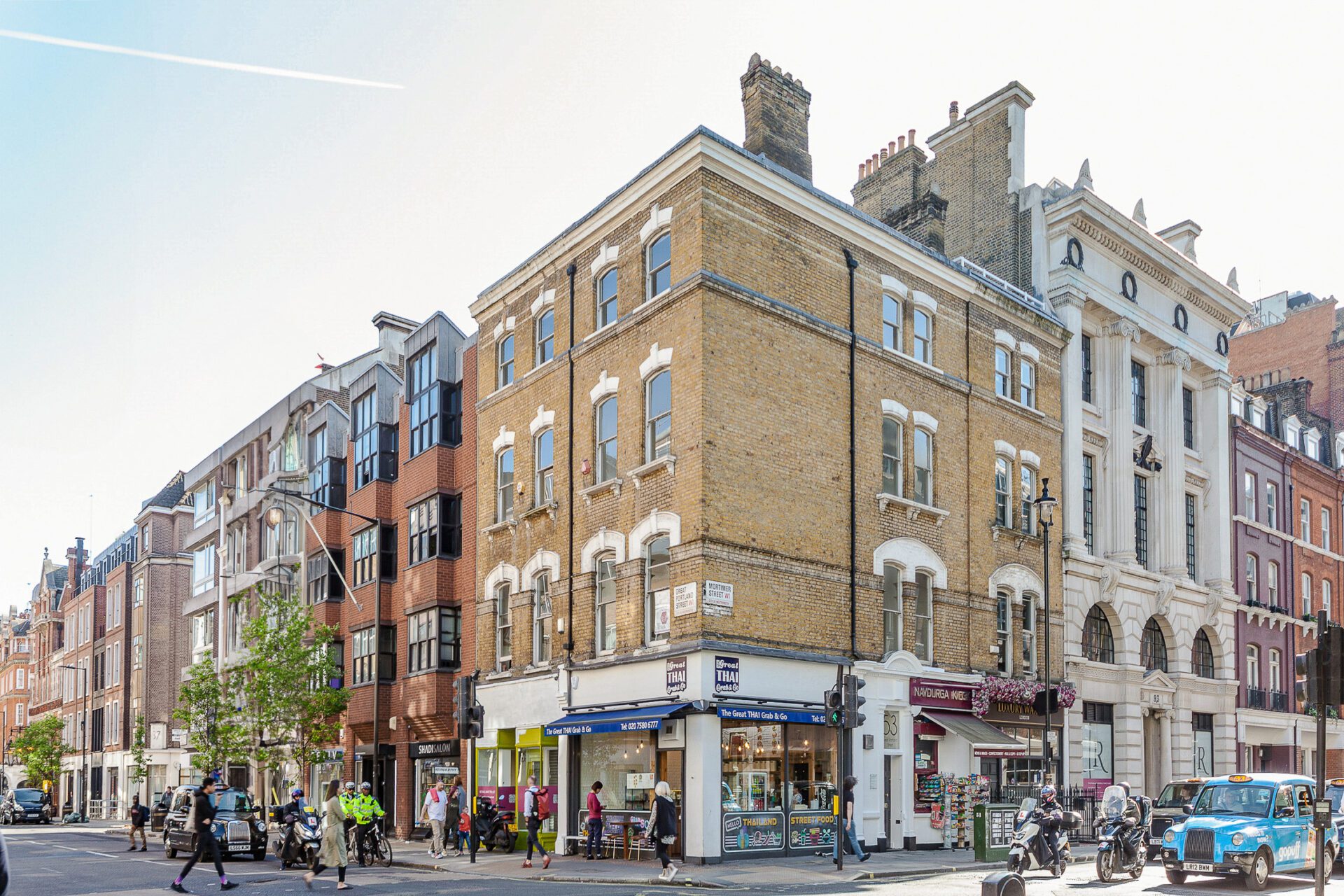
Great Portland Street, part of Fitzrovia’s Golden Triangle (2), has built a reputation as a corporate stronghold housing global law, finance and consulting firms, which makes it worth including on a legal shortlist even without a traditional legal postcode.
This option can also work when your firm wants serviced office space rather than taking responsibility for fitting out a conventional office. A smaller practice can start with the number of desks it needs now, then look for a larger suite when recruitment creates an actual need for more space.
If Fitzrovia suits your practice, the type of office you choose should reflect your team size, need for privacy and how frequently clients visit. Current options from The Langham Estate include:
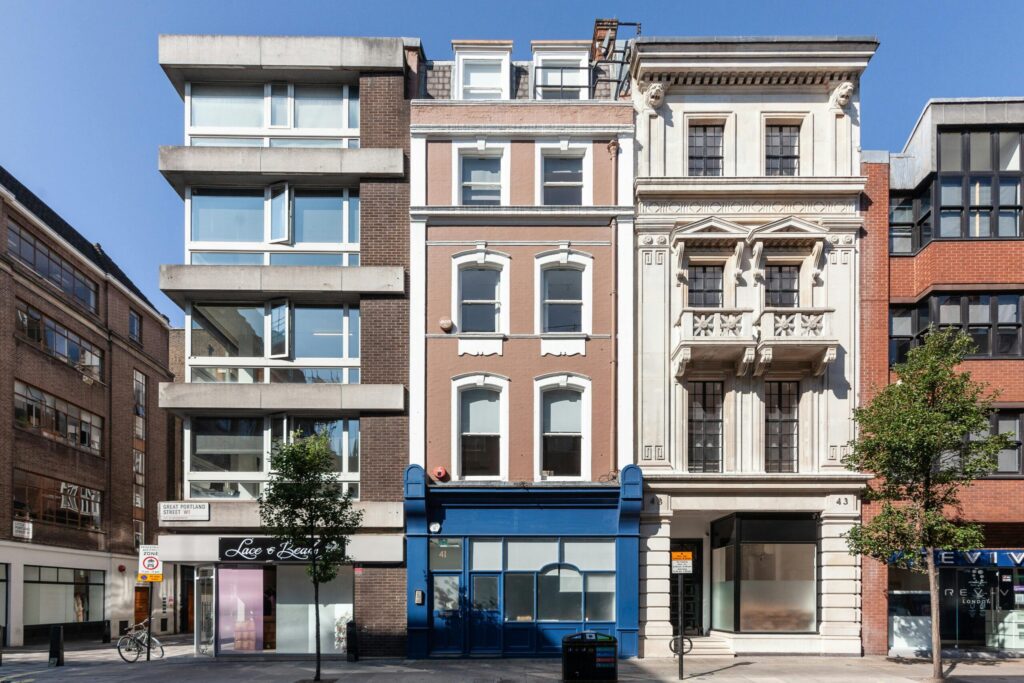
- 42-48 Great Portland Street, Multiple floors – 42–48 Great Portland Street in Fitzrovia offers newly refurbished, self-contained traditional office space in a prime core central London location, just minutes from Oxford Circus. The 3rd floor provides 1,433 sq ft at £70 psf, with space for up to 14 workstations plus touchdown areas, a kitchenette, private WCs and a shower, while the smaller 5th floor offers 784 sq ft at the same £70 psf, accommodating up to nine workstations with its own kitchenette and private facilities.
- Portland House, 3rd Floor West – A 1,691 sq ft refurbished office accommodating up to 19 workstations, with natural light, air conditioning, a kitchenette and 24-hour access. Located close to Oxford Circus, it could suit a smaller or specialist practice looking for a manageable Central London office rather than a much larger conventional floor.
- 85 Mortimer Street, First to Third Floor – A 1,248 sq ft self-contained office arranged across three floors with its own street entrance, private kitchenette, WC and shower. The separation between floors and private entrance may be particularly useful for a legal practice that wants clearer separation between working areas and client-facing space.
2. Chancery Lane for an established legal address
Chancery Lane is one of the first areas you should consider when your business needs regular contact with solicitors, barristers and other legal professionals. The Law Society has its principal place of business at 113 Chancery Lane, which keeps the area closely connected with the solicitors’ profession, according to Law Society.
For litigation and dispute resolution teams, the location also reduces the distance between your office and several parts of London’s legal quarter. Your lawyers can arrange meetings with counsel without turning a short appointment into a journey across the city.
The main point to check is the building rather than the postcode alone. Chancery Lane contains different types of office stock, so inspect meeting room availability, lifts, internet capacity, reception arrangements and the amount of space your team can actually use.
3. Holborn for firms that need more central connections
Holborn gives you access to the legal quarter while keeping your office connected with other parts of Central London. This can work for firms with a mixture of litigation, employment, commercial, property or advisory work rather than one practice that keeps everyone around the courts each day.
A practical way to assess Holborn is to map your team’s regular destinations for one month. Check journeys to courts, chambers, client offices and railway stations, then compare them with another potential area before you look at rent.
A common mistake is choosing an office simply because it is slightly closer to one important legal institution. For example, saving fifteen minutes on a trip your team makes four times a week can be more useful than saving thirty minutes on a meeting that only happens twice a year.
This is why you should look at your team’s most frequent journeys before deciding which area is actually more convenient.
4. Temple and Fleet Street for court-based legal work
Temple and Fleet Street make practical sense when court work and meetings with barristers form a large part of your week. Inner Temple is based at EC4Y 7HL, while Middle Temple has its Treasury Office on Middle Temple Lane at EC4Y 9BT.
Being close to these institutions can reduce travel between your office, counsel meetings and hearings. Fleet Street also places you between the traditional legal quarter and the commercial parts of the City, which can help firms handling both disputes and business matters.
Building choice needs more attention in this part of London. Some firms may prefer traditional premises, while others need modern meeting technology, larger team rooms and easier access for visitors.
During a viewing, ask: “Can a client arrive, wait and enter a private meeting room without passing through our main working area?” That question gives you useful information about how the office will operate once confidential meetings begin.
5. City of London for corporate and commercial law firms
The City of London should be high on your list when your lawyers regularly advise banks, insurers, investment companies and large businesses. Instead of travelling into the City several times a day, your team can arrange meetings closer to the office and return to their desks more quickly.
The demand from the legal sector still remains strong, meaning you should start looking before your current agreement is close to expiry, particularly when you need a specific floor size or building standard. Larger teams have fewer realistic options than a four-person practice that can choose between several serviced offices.
Cost also needs careful attention. Knight Frank reported prime headline rents of £102.50 per square foot in the City Core for 2025, compared with £185 per square foot in the West End Core. These figures describe prime space rather than every office in each district, but they show how much location and building quality can influence your budget.
A closer look at Fitzrovia’s office rental price trends (1) shows how a nearby West End district compares on cost for firms not tied to a City address.
6. Mayfair and St James’s for private client work
Mayfair and St James’s can work for firms serving high net worth individuals, family offices, property clients and international businesses that already hold meetings in the West End. In that situation, the location can shorten client journeys and place your lawyers near other professional advisers.
Paying for the address needs a commercial reason, however. If most of your matters involve City businesses or regular court appearances, a West End office may increase rent without reducing travel.
A practical way to decide is to review your last 30 to 50 face-to-face client meetings. If a large share already takes place around Mayfair, St James’s or neighbouring West End areas, the location has a clearer operational benefit.
Paying extra for a recognised postcode does not guarantee that more clients will come through the door. It makes more sense to choose an area where your existing and target clients already spend time, then treat the reputation of the address as an added benefit.
7. Canary Wharf for financial services practices
Canary Wharf makes more sense when your client list is concentrated in banking, investment and financial services. Lawyers working repeatedly with organisations in Docklands may save more time by sitting near their clients than by choosing a traditional legal address further west.
However, the downside is its distance from the courts. If your team regularly handles litigation, travelling to hearings or meetings around Temple, Fleet Street and Chancery Lane could add extra time to the working day.
Before choosing Canary Wharf, calculate where your lawyers spent their external working hours during the previous three months. If most of those hours were with financial clients in the area, the location becomes easier to justify.
Base your new office in Fitzrovia with The Langham Estate
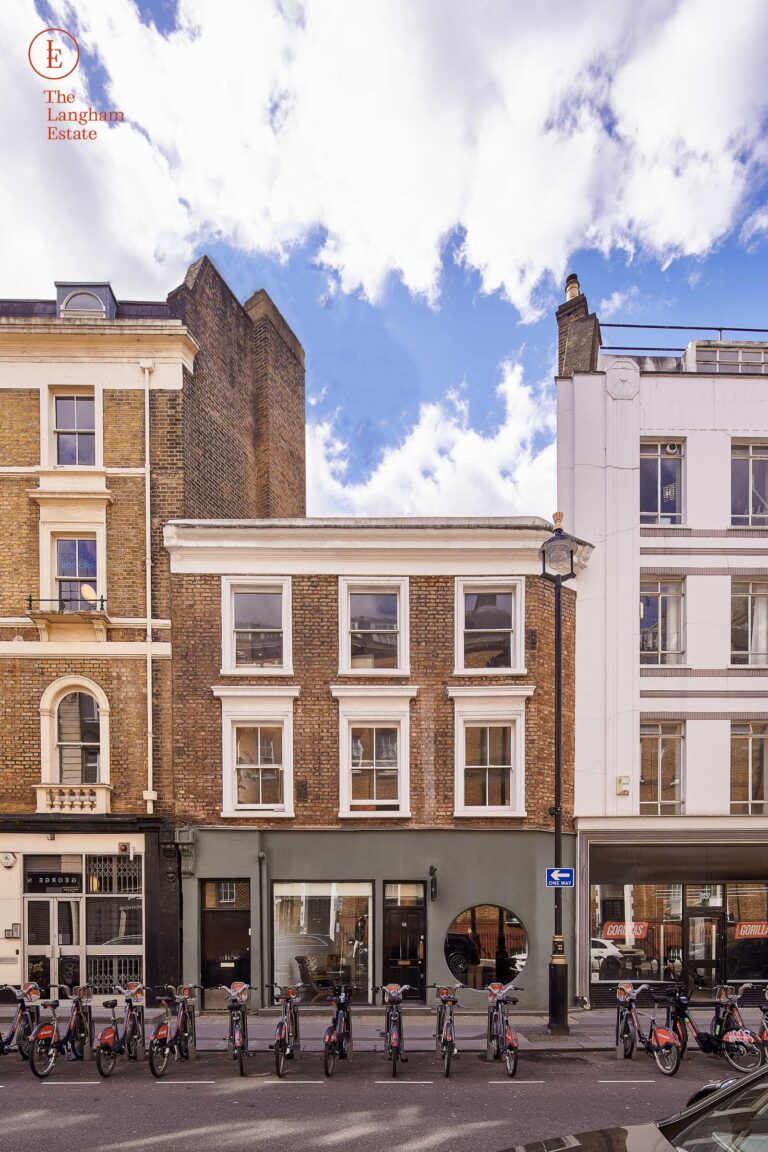
Fitzrovia sits close enough to Holborn and the West End to suit a growing legal practice without the traditional legal quarter price tag. The Langham Estate manages offices and serviced space across the area, including offices on Great Portland Street, giving your team room to start small and take a larger floor as the firm grows.
Fitzrovia sits close enough to Holborn and the West End to suit a growing legal practice without the traditional legal quarter price tag. The Langham Estate manages offices and serviced space across the area, including offices on Great Portland Street, giving your team room to start small and take a larger floor as the firm grows.
Reference
1. Fitzrovia’s office rental price trends 2025: comparison with Mayfair & Soho
2. Fitzrovia’s ‘Golden Triangle’: Great Portland St., Margaret St., Mortimer St