What happens if I leave a commercial lease early? Your options explained

A company may need to relocate, but unlike a simple change of address, ending a commercial lease early involves legal obligations that require careful consideration. If you are asking, “what happens if I leave a lease early?”, the answer depends largely on the terms of your lease agreement and whether your landlord is willing to agree to an alternative arrangement.
In most cases, you cannot simply hand back the keys and stop paying rent. A commercial lease is a legally binding contract, meaning you may remain responsible for rent and other obligations until the lease expires or an agreed exit route is completed. The good news is that tenants often have several options available. Depending on your circumstances, you may be able to use a break clause, negotiate a surrender with your landlord, transfer the lease to another business, or sublet the premises.
Can you leave a commercial lease early?
A commercial lease normally continues until the agreed expiry date unless there is a specific mechanism allowing it to end sooner. This means that simply vacating the premises does not automatically terminate your responsibilities as a tenant. Even if your business has moved elsewhere, you may still need to pay rent, service charges and comply with other lease obligations.
Before taking any action, the first step is to carefully review your lease agreement. The wording of your contract will determine whether you have the right to leave early and what conditions you must satisfy. Commercial leases vary significantly, so an option available to one tenant may not be available to another.
As outlined in the official UK government portal, the main ways a tenant may exit a commercial lease early include: Break clause, lease surrender, asignment, subletting.
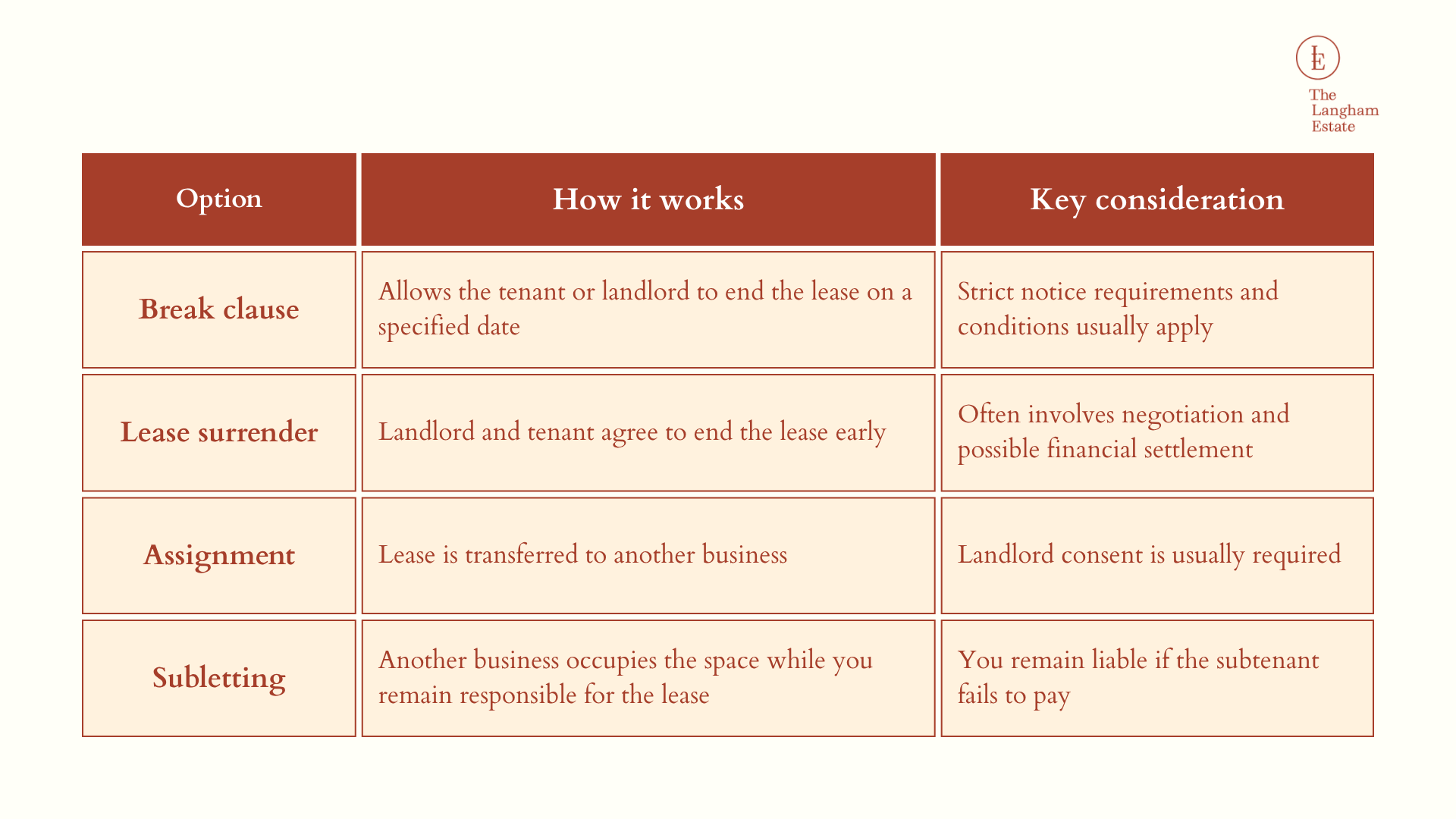
Each option has different legal and financial implications, so choosing the right approach depends on your business position, the lease terms and the relationship with your landlord.
What happens if I leave a lease early without agreement?
Many tenants assume that moving out of a commercial property ends their responsibility. However, this is generally not the case. Unless the lease has been legally terminated or transferred, the tenant usually remains responsible for meeting the agreed obligations.
You may still be responsible for rent
If you leave the premises before the lease expiry date without using a break clause or agreeing an alternative arrangement, you will usually still need to pay rent for the remaining lease term.
For example: if a business has 3 years remaining on its office lease and simply moves to another location, the original landlord may still expect payment unless the lease has been legally ended or another tenant takes over through an approved arrangement.
This is why businesses should begin discussions early. A landlord may be more willing to consider solutions when there is sufficient time to find a replacement occupier rather than being approached after the tenant has already vacated.
You could face additional costs
Rent is not the only financial consideration when leaving a commercial lease early. Depending on your lease terms, you may also need to consider:
- Outstanding service charges
- Repairs required under the lease
- Dilapidation costs at the end of occupation
- Legal fees
- Costs associated with finding a replacement tenant
Commercial leases often contain complex legal obligations, and leaving without following the correct process can significantly increase both financial and legal risks. In many cases, there are practical options that can reduce costs, protect your business interests and help you reach an agreement with your landlord.
The key is to understand the available routes and choose the one that best fits your circumstances. Let’s explore the most common ways businesses can leave a commercial lease early responsibly.
Option 1: Use a break clause
A break clause is one of the most straightforward ways to end a commercial lease early, but only if your lease includes one. A break clause is a contractual provision that allows the tenant, landlord or both parties to terminate the lease on a specified date before the original expiry date.
Not all commercial leases include a break clause. If your lease does contain one, it will usually specify exactly when and how it can be used. This may include requirements such as giving a certain amount of notice, paying rent up to a specific date and complying with other lease obligations.
Check the conditions before exercising a break clause
Although a break clause provides an early exit option, it is not automatically guaranteed. Many clauses include strict conditions that must be satisfied for the termination to be valid.
Common requirements may include:
|
Requirement |
Why it matters |
|
Correct notice period |
Missing the deadline may invalidate the break notice |
|
Correct method of service |
Notice must usually be delivered in the format specified in the lease |
|
Rent payments up to date |
Outstanding payments may prevent the break from being effective |
|
Vacant possession |
The tenant may need to leave the premises completely empty and accessible |
|
Compliance with lease terms |
Breaches of obligations may affect the right to break |
Because break clauses are interpreted strictly, tenants should not assume that simply sending a notice is enough. The process should be carefully checked against the exact wording of the lease.
Common mistakes when using a break clause
One of the most common problems is serving notice too late. Commercial leases often require several months’ notice before the break date, meaning tenants need to plan well in advance.
Another issue is misunderstanding what “vacant possession” means. A tenant may need to remove furniture, equipment and belongings completely rather than simply stop trading from the premises.
Businesses should also check whether rent, service charges and other payments have been settled correctly before exercising the break. Even minor errors can create disputes and potentially prevent the lease from ending as intended.
Option 2: Negotiate a surrender with your landlord
If your lease does not include a break clause, or if the break date is too far away, another option is negotiating a lease surrender. A surrender occurs when both the landlord and tenant agree to end the lease before its contractual expiry.

Unlike a break clause, surrender is not a right that one party can automatically enforce. The landlord must agree to accept the property back, and negotiations are usually required to reach terms that work for both sides.
How a lease surrender works
According to guidance from the official UK government portal on surrender by deed, this process is typically finalized through a formal legal document known as a deed of surrender. This agreement confirms both parties’ mutual consent to terminate the lease and outlines any accompanying terms and conditions.
Some of the terms include:
- The date the lease ends
- Any compensation payment
- Responsibility for repairs
- Settlement of outstanding charges
- Return of keys and possession of the property
The exact agreement depends on the circumstances of the tenant, landlord and property.
Why might a landlord agree to an early lease surrender?
A landlord is not required to accept a surrender, so understanding their perspective is important. They will usually consider whether ending the lease early creates a commercial advantage or disadvantage.
A landlord may be more open to discussions if:
- There is strong demand for the property
- A replacement tenant can be found quickly
- The property is suitable for reletting
- The landlord has plans to refurbish or redevelop the space
- The tenant offers a reasonable financial settlement
Market conditions can significantly influence negotiations. In a strong rental market, a landlord may prefer to release the existing tenant and secure a new occupier at current market rates. In a weaker market, they may be more cautious because finding a replacement tenant could take longer.
Consider the cost of surrender carefully
Negotiated surrender can provide certainty, but it may involve a payment to compensate the landlord for ending the lease early. This could include lost rent, marketing costs, legal expenses or other financial impacts.
For some businesses, paying a surrender premium may still be the most cost-effective option compared with continuing to pay rent on an unsuitable office for several years. The right decision depends on the remaining lease term, the cost of relocation and the company’s future plans.
Option 3: Assign the lease to another business
If negotiating a surrender is not practical, assigning the lease may be another way to leave a commercial property early. Lease assignment involves transferring your existing lease to another business, meaning a new tenant takes over your rights and responsibilities for the remainder of the lease term.
For businesses that no longer need their current premises but still have significant time remaining on their lease, assignment can be a practical solution. It allows the company to avoid carrying the full cost of an unused office while allowing another occupier to take advantage of an existing lease agreement.
However, assignments do not happen automatically. Most commercial leases require the landlord’s consent before a transfer can take place, and landlords will usually want to assess whether the incoming tenant is suitable.
How does lease assignment work?
The process usually involves finding another business that is willing to take over the lease. This could be another company looking for office space, a business expanding into the area, or an organisation seeking premises with an existing lease structure.
Before approving the transfer, the landlord may review factors such as:
- The incoming tenant’s financial position
- Business activities and suitability for the property
- Ability to meet rental obligations
- Proposed use of the premises
- Compliance with building regulations and lease restrictions
Once approved, legal documents are prepared to transfer the tenant’s interest in the lease to the new occupier.
Understand your ongoing liability after assignment
Although assignment transfers the lease to another business, the original tenant may not always be completely free from responsibility.
According to Section 16 of the Landlord and Tenant (Covenants) Act 1995, commercial leases require an outgoing tenant to provide an Authorised Guarantee Agreement (AGA). This is a legal agreement where the former tenant guarantees that the incoming tenant will meet their obligations under the lease.
For example, if the new tenant fails to pay rent or breaches the lease terms, the landlord may have the right to pursue the original tenant under the AGA.
This means businesses should carefully review the proposed assignment terms before assuming they have completely removed themselves from the property obligation.
When is assignment a suitable option?
Assignment can be particularly useful when:
- Your business has outgrown the premises
- You are relocating to another city or country
- The remaining lease term is attractive to other occupiers
- The property is in a desirable location
- You want to avoid the cost of continuing to occupy unused space
However, if the office requires significant repairs, has above-market rent or is in an area with low demand, finding a replacement tenant may be more challenging.
Option 4: Sublet the property to another business
Subletting is another possible solution when you no longer need all or part of your office space but do not want to permanently exit the lease.
Unlike assignment, subletting does not transfer the lease to another business. Instead, you remain the legal tenant and allow another company to occupy the premises in exchange for rent.
This can provide flexibility for businesses that need to reduce costs temporarily or are unsure about their long-term requirements.
How subletting differs from assignment
Although assignment and subletting can both help reduce the financial impact of an unwanted office, they work differently.
|
Assignment |
Subletting |
|
|
Lease ownership |
Transfers to a new tenant | Remains with the original tenant |
|
Relationship with landlord |
New tenant becomes directly responsible | Original tenant remains responsible |
|
Rent responsibility |
Usually transferred, subject to lease terms | Original tenant remains responsible |
|
Best suited for |
Businesses leaving permanently | Businesses needing temporary flexibility |
Understanding this difference is important because subletting does not remove your obligations under the original lease.
Landlord consent
Most commercial leases include restrictions on subletting. Before allowing another business to occupy your office, you will usually need written permission from your landlord.
A landlord may consider:
- Whether the proposed occupier is financially reliable
- Whether their business activity is suitable
- Whether the sublease terms comply with the original lease
- Whether the building’s reputation or operations could be affected
Subletting without permission could place you in breach of your lease, creating further complications.
Consider the risks of subletting
While subletting can reduce your rental costs, the original tenant remains responsible to the landlord.
For example, if your subtenant stops paying rent, you are still responsible for paying your landlord. You may then need to pursue the subtenant separately to recover unpaid amounts.
For this reason, businesses should carefully assess potential subtenants and ensure appropriate legal agreements are in place.
What should you do before leaving a commercial lease early?
Before deciding how to exit your lease, take a structured approach. The right solution depends on your lease terms, financial position and future business plans.
Review your lease agreement carefully
Start by identifying:
- Whether a break clause exists
- The lease expiry date
- Notice periods
- Assignment and subletting restrictions
- Repair obligations
- Any rent review provisions
If you are unsure about the wording, a commercial property solicitor can help explain your rights and responsibilities.
Speak with your landlord early
Open communication is often one of the most effective ways to achieve a positive outcome. Landlords generally prefer certainty, and an early conversation gives them more time to consider options.
A landlord may be more willing to negotiate if they understand your situation and have enough time to plan for the property’s future.
Planning your next office move
For many businesses, leaving a commercial lease early is not about reducing their presence—it is about finding a workspace that better supports their next stage of growth.
Companies may move because they need:
- More suitable space for employees
- A better location for clients
- Lower occupancy costs
- Improved workplace facilities
- Greater flexibility
The experience of leaving one office can also highlight what matters most in the next property decision.
Choose an office that supports future flexibility
When searching for a new workspace, consider not only your current requirements but also how your business may change.
Important factors include:
- Flexible lease terms
- Ability to expand within the building
- Transport accessibility
- Quality of the surrounding area
- Workplace facilities
- Landlord experience
A well-chosen office can support recruitment, productivity and client relationships while reducing the likelihood of needing another disruptive move in the near future.
Finding flexible office space in Fitzrovia with The Langham Estate

When businesses leave a commercial lease early, the next challenge is often finding a workspace that provides the right balance of location, flexibility and long-term suitability.
The Langham Estate works with occupiers looking for offices and retail spaces in the heart of the Fitzrovia Quarter, with properties positioned between Oxford Street to the south and Great Portland Street station to the north. Some of the available office opportunities include spaces offered with flexible terms by arrangement for you to :
- 4th Floor, 75–77 Margaret Street – A well-located office space in Fitzrovia, suitable for businesses seeking a professional Central London base close to excellent transport connections and local amenities.
- 3rd Floor, 19-21 Great Portland Street – Located near Great Portland Street station, this office provides convenient access to the wider West End and surrounding business districts.
- Ground floor, 21 Great Titchfield Street – A prominent Fitzrovia property offering businesses the opportunity to operate within one of Central London’s established commercial neighbourhoods.
To find the perfect fit for your business, explore more options at our Central London office space options to choose your future office.

Conclusion
Whether you use a break clause, negotiate a surrender, assign the lease or sublet the space, early planning gives you more control over the outcome. Speaking with your landlord and professional advisers at an early stage can help you find the most practical solution for your business.
For companies relocating or searching for a new London workspace, choosing a flexible and well-connected office location is equally important. If you are ready to find a versatile workspace tailored to your business needs, explore the commercial portfolio available at The Langham Estate.
Whether you use a break clause, negotiate a surrender, assign the lease or sublet the space, early planning gives you more control over the outcome. Speaking with your landlord and professional advisers at an early stage can help you find the most practical solution for your business.
For companies relocating or searching for a new London workspace, choosing a flexible and well-connected office location is equally important. If you are ready to find a versatile workspace tailored to your business needs, explore the commercial portfolio available at The Langham Estate.
FAQs
What happens if I leave a lease early?
If you leave a commercial lease early without agreement, you may still be responsible for rent and other lease obligations until the lease expires. Your options may include using a break clause, negotiating a surrender, assigning the lease or subletting the premises, depending on your lease terms.
Can I just hand back the keys and leave my commercial property without notifying the landlord?
No. Simply leaving the property does not usually end your legal responsibilities. Unless the lease has been formally ended or transferred, you may remain responsible for rent, repairs and other obligations.
What is the difference between surrender and assignment?
A surrender ends the lease completely through agreement between landlord and tenant. Assignment transfers the lease to another tenant, although the original tenant may still have some ongoing liability depending on the lease terms.
Can I sublet my office without landlord permission?
Usually not. Most commercial leases require landlord consent before a tenant can sublet all or part of the premises. Subletting without approval could put you in breach of your lease.
Do I need a solicitor to leave a commercial lease early?
While not always legally required, obtaining advice from a commercial property solicitor is strongly recommended. Lease exits involve complex contractual obligations, and professional advice can help avoid costly mistakes.
What happens to a commercial lease if a business stops trading?
A common misconception is that closing a business automatically ends its commercial lease.If your company stops trading but the lease remains active, you still need to pay rent and service charges, maintain the property according to lease requirements, keep insurance arrangements in place, and comply with other lease obligations.