The hidden costs of renting an office in Central London
When you are comparing offices in London, the headline rent is only the starting point. The figure quoted per square foot may look manageable, but it does not necessarily include the legal work, deposit, fit-out, technology, business rates, service charges and day-to-day costs that come with occupying the space.
That is why we think it is more useful to look at the full cost of an office from the day you agree to the lease. Below, we break those expenses into one-time, recurring and end-of-lease costs, so you can build a more realistic budget before choosing your next London office.
One-time hidden costs of office rental in London
Before your first normal month of occupancy, there can be a surprising amount to pay for. These one-time costs generally fall into four areas: securing the lease, preparing the office, setting up technology and physically moving your team in.
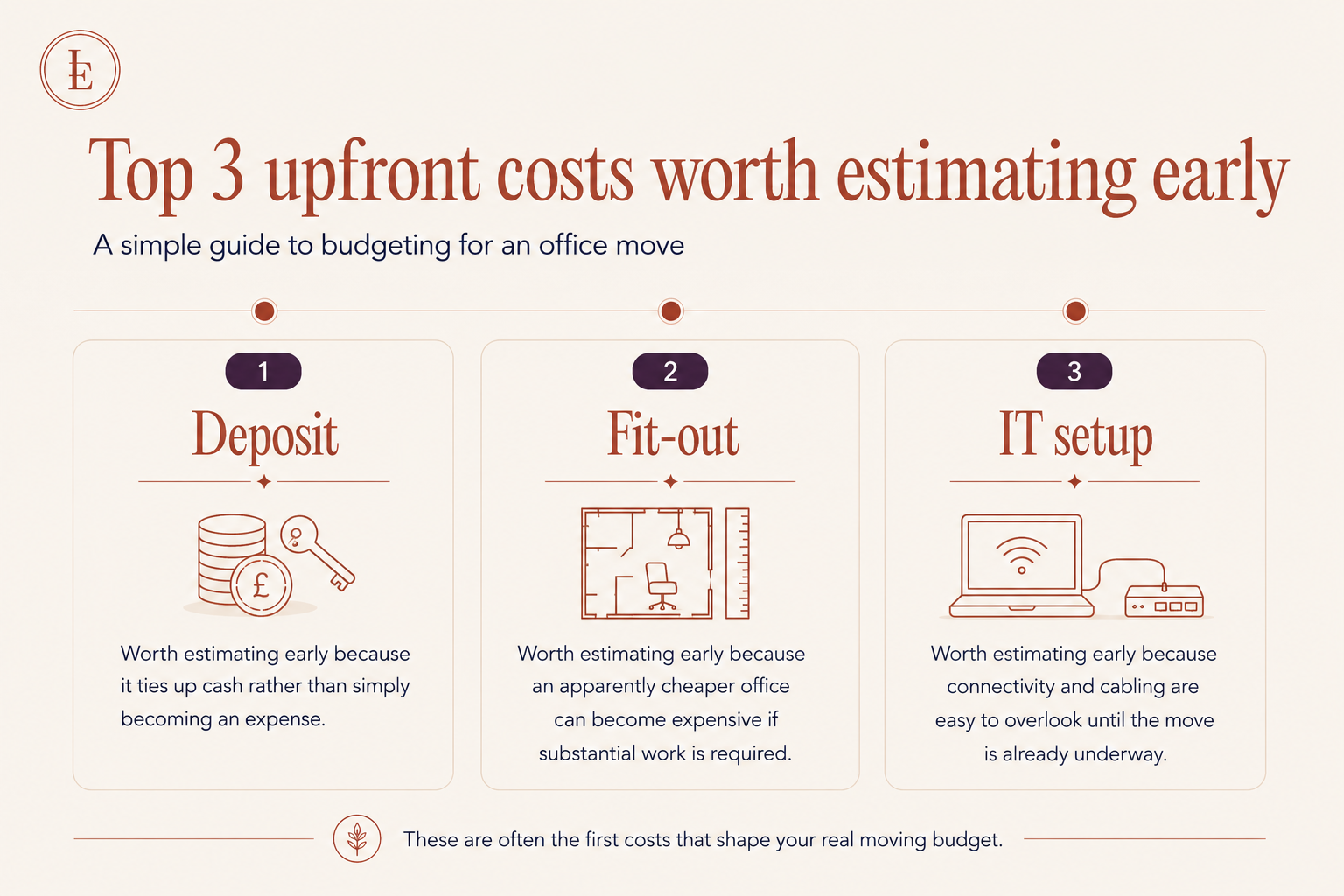
Legal and lease costs: You will usually need a commercial property solicitor to review and negotiate the lease, carry out relevant searches and deal with the legal paperwork. Pay particular attention to repair obligations, break clauses and reinstatement requirements, as these can create much larger costs later.
Stamp Duty Land Tax (SDLT): Depending on the rent, lease length and any premium paid, SDLT may be due when taking a commercial lease. Include this in your initial budget rather than treating the quoted rent as the full cost of securing the premises.
Property agent fees: Many businesses appoint a commercial property agent to search the market and negotiate with the landlord. Confirm how the agent is paid and what is included in their fee before instructing them.
Surveyor and property checks: A building survey can identify problems with the condition of the office before they become your responsibility. So it’s best to understand exactly which repairs the lease makes you responsible for, particularly with older or previously occupied buildings.
Rent deposit and financial guarantees: A landlord may request a deposit, rent in advance, a guarantor or a bank guarantee before agreeing the lease. A large deposit can tie up working capital for several years, so factor the cash-flow impact into your office budget.
Office fit-out: Partitioning, flooring, lighting, kitchens, meeting rooms, decoration and other works may be required before the office is ready for your team. Note that the cheaper office on paper may not be cheaper overall if it needs substantial work before you can move in.
Furniture: Desks, chairs, storage and meeting or breakout furniture can become a considerable one-off expense for a larger team.
IT and connectivity: Confirm broadband availability and installation lead times early, as a finished office without a working connection is not much use to your team.
Security and access setup: Access-control systems, CCTV, alarms or additional entry cards may need to be installed depending on what the building already provides. What to check: ask what is included by the landlord or building management so you do not pay twice for systems already in place.
Moving costs: Removal companies, furniture delivery, assembly, temporary storage and loading or parking charges can all add to moving-day expenditure. A pro tip: allowing a short overlap between your old and new offices can make the move easier, but it may also mean paying for two spaces at the same time.
Signage and final setup: Reception branding, window graphics, stationery and other finishing touches are often left until the end of the budget. Exterior signs or window graphics may require landlord approval, so check what is permitted before ordering them.
Recurring costs while you occupy the office
Once you are in the office, your ongoing cost will usually be higher than the rent shown in the property listing. Some expenses are fixed or relatively predictable, while others depend on the building, your lease and how your team uses the space.
As a broad Central London benchmark, recurring occupancy costs can add around 30–60% on top of the headline rent (Source). The exact figure depends heavily on the building, location, business rates and what the service charge already includes.
For prime offices, the absolute numbers can be much higher. Carter Jonas reported 2026 combined rent + business rates + service charge occupancy costs of about £143 per sq ft per year in the prime City core, rising to around £262.50 per sq ft in prime West End space.
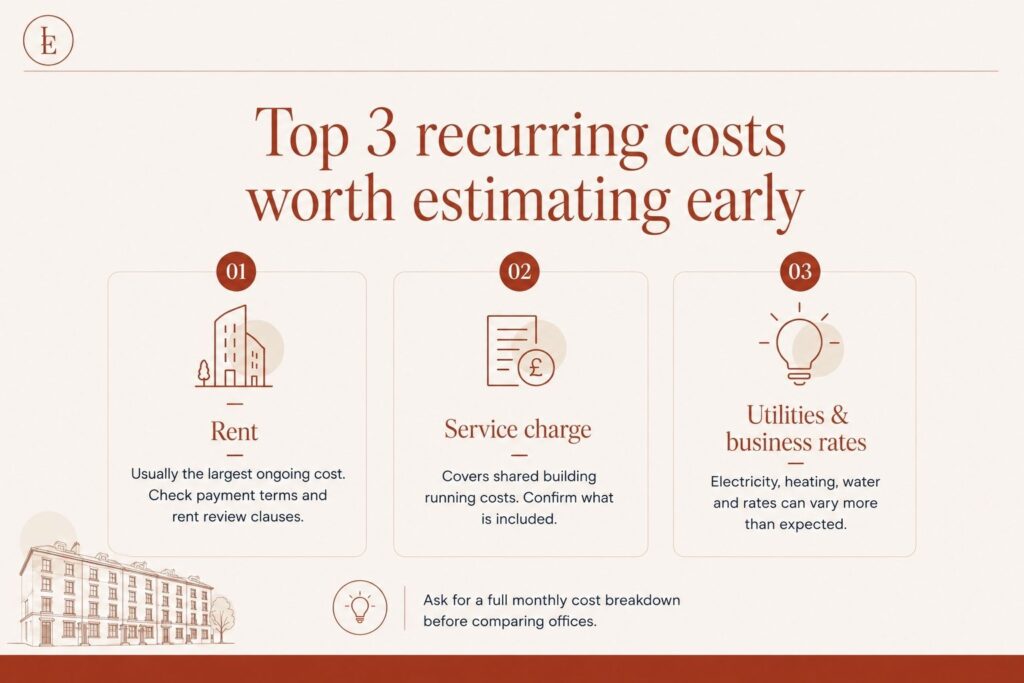
1. Property and Building Costs
These are usually the largest recurring costs attached directly to occupying the office.
- Base rent: The regular payment made to the landlord for use of the space.
- Business rates: Commercial property tax payable on most office premises, subject to any applicable relief.
- Service charge: Your share of costs for communal areas and building services such as reception, lifts, security and shared maintenance.
- Building insurance and management charges: Some leases pass on a contribution towards the landlord’s insurance, estate management or facilities management.
- Rent reviews: On longer leases, the rent may be reviewed and increased at agreed points during the term.
Worth knowing: When comparing offices, ask for the current service-charge budget and recent actual expenditure. Two properties with similar rents can have very different overall occupancy costs.
2. Utilities and Building Services
Utilities can either be billed directly to your business or recovered through the landlord or managing agent.
- Electricity, gas and water: Your normal energy and water consumption.
- Heating and air conditioning: These may be included within another building charge or billed separately.
- Standing and energy-management charges: Some suppliers or buildings apply fixed charges alongside actual usage.
- Out-of-hours HVAC: Heating or cooling outside standard building hours can sometimes incur an additional charge.
Worth knowing: If your team regularly works evenings or weekends, ask for the building’s normal operating hours before signing. Out-of-hours air conditioning can be an easy cost to overlook.
Cleaning, Facilities and Maintenance
A service charge does not always cover everything needed to maintain the inside of your own office.
- Office and window cleaning
- Waste collection and recycling
- Repairs and routine maintenance
- Pest control
- Washroom and kitchen consumables
- Facilities-management support
Worth knowing: Ask exactly where the landlord’s responsibility ends. Shared-area cleaning may be included, for example, while cleaning and repairs inside your own office remain your responsibility.
3. Technology and Connectivity
Technology costs can become a significant part of the monthly office budget, particularly for larger or hybrid teams.
- Internet and backup connectivity
- Wi-Fi and phone systems
- IT support and hardware maintenance
- Cybersecurity and data backup
- Cloud services and software licences
- Video-conferencing and meeting-room systems
Worth knowing: A building being “fibre enabled” does not necessarily mean your individual office is already connected. Confirm the existing infrastructure before committing to a provider.
4. Security and Access
Some security services are included within the building package, while others may be charged separately.
- CCTV and alarm monitoring
- Security staff
- Access cards and replacement keys
- Access-control maintenance
- Out-of-hours building access
Worth knowing: If you need 24/7 access, confirm what changes outside normal hours. Extra security, reception or building services may apply.
5. Workplace and Day-to-Day Operations
These are generally smaller costs, but they can become significant as the team grows.
- Reception and mail handling
- Printing and stationery
- Coffee, drinking water and kitchen supplies
- Meeting-room subscriptions or AV services
- Parking, lockers and cycle facilities
- Other office consumables
Worth knowing: Before arranging separate suppliers, check what the landlord or building operator already provides. Bundled services can remove several smaller monthly expenses.
End-of-lease costs to plan for
Leaving an office can create a final round of costs well before the last box is moved out. The biggest expense is often returning the property to the condition required by the lease, but professional fees, removals and final occupancy costs should also be included.
These end-of-lease costs should be best treated as a planning allowance rather than a standard charge. Current London market guidance puts office dilapidations alone at approximately £15–£35 per sq ft. More complex strip-outs and reinstatement programmes can reach roughly £30–£40 per sq ft before considering separate moving, storage or professional costs (Source).
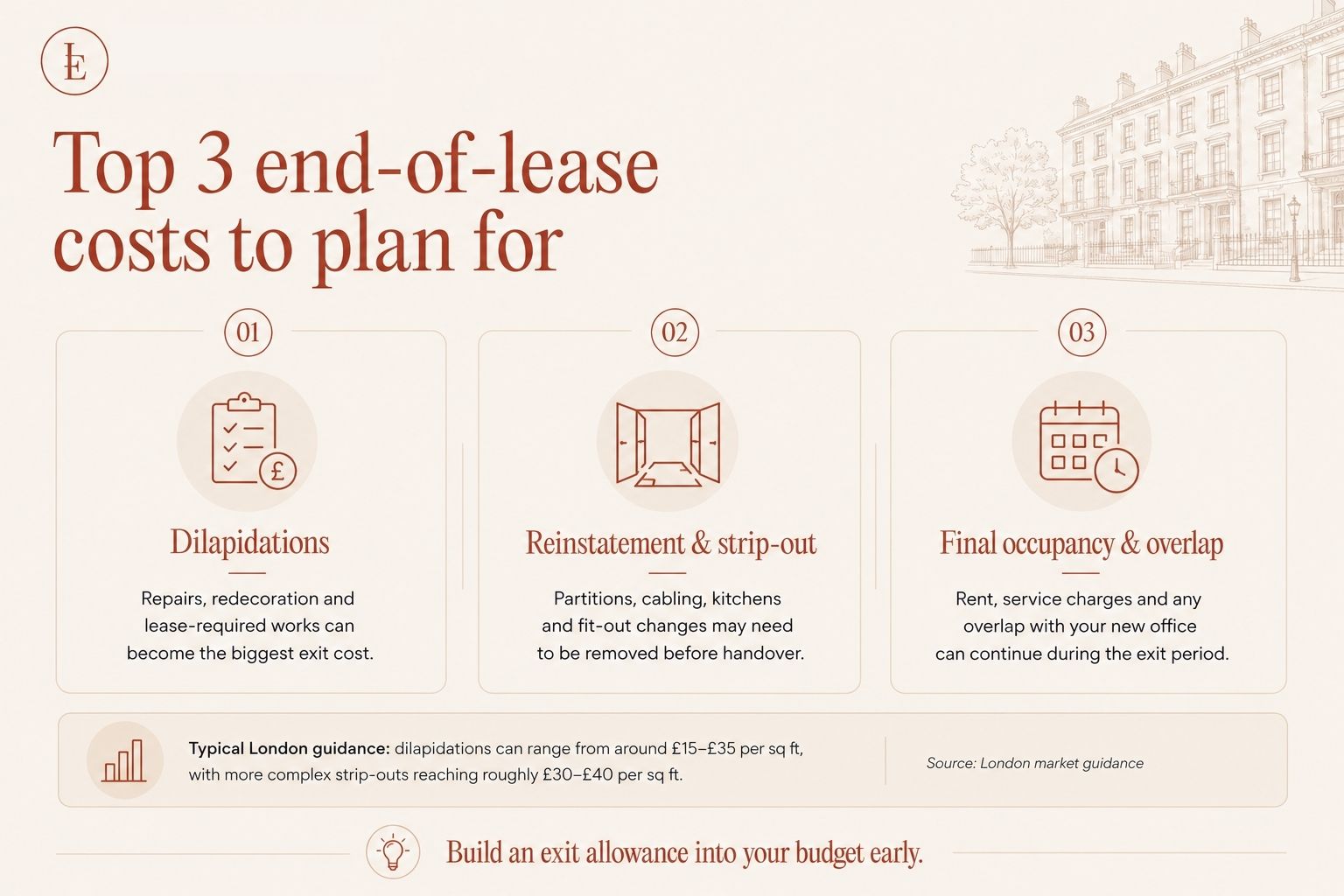
Dilapidations: Your landlord may require repairs, redecoration or other works needed to return the office in the condition required by the lease. It is worth having the landlord’s Schedule of Dilapidations reviewed rather than assuming every item or cost in the initial claim is automatically your responsibility.
Reinstatement and strip-out: If you installed partitions, meeting rooms, kitchens, cabling, signage, bespoke flooring or other alterations, you may need to remove them and restore the original layout. Even improvements that made the office better for your business can become an exit cost if the lease requires them to be reversed.
Repairs and redecoration: Flooring, ceilings, doors, lighting, plumbing and decorative finishes may need attention before handover. Allow enough time for these works before the lease-end date rather than discovering defects during the final inspection.
Professional fees: A dilapidations surveyor, solicitor or other adviser may be needed to review the landlord’s claim, negotiate liability and agree a settlement. For a larger office, professional advice can be worthwhile because the landlord’s initial schedule may not necessarily equal the final amount payable.
Moving and storage costs: Removal companies, temporary storage, furniture transport and specialist IT relocation all need to be budgeted for again when you leave. Decide early what is actually moving to the new office so you do not pay to transport furniture or equipment that will ultimately be disposed of.
Furniture, IT and waste disposal: Items that are not moving with you may require resale, recycling, secure IT disposal, data destruction or commercial waste collection. This can become more complicated where large quantities of furniture or electrical equipment need to be cleared before handover.
Final cleaning: A deep clean may be required once furniture and equipment have been removed, particularly if the lease specifies a particular hand-back condition.
Rent and service charges during the exit period: Your rent, service charge and other occupancy costs generally continue until the lease actually ends, even if most employees have already moved elsewhere. Make sure the exit programme leaves enough time for reinstatement and cleaning before that date.
Office overlap: Moving gradually can reduce disruption, but there may be a period when you are paying for both your old office and the new one. For larger moves, this overlap can become one of the most significant non-dilapidation exit costs.
How to calculate the true cost of a Central London office?
If you are trying to work out how much does it cost to rent an office, don’t start with the advertised rent. A more practical approach is to take one shortlisted office and build up its cost step by step.
For example, imagine a 30-person company looking for a conventional leased office in Central London.
It’s best to open a spreadsheet and follow this order:
Step 1: Work out how much space you actually need.
Before looking at rent, calculate office space around how your team actually works: desk numbers, meeting rooms, breakout areas and hybrid attendance. In this example, the company decides that around 2,000 sq ft will comfortably support its 30-person team.
Step 2: Calculate the headline rent.
The company finds a 2,000 sq ft office advertised at £80 per sq ft per year:
2,000 sq ft × £80 = £160,000 annual rent
That £160,000 is the number you will normally see first, but it is not yet the real annual cost.
Step 3: Add business rates and service charge.
Use the GOV.UK business-rates service to check the property’s rateable value, and ask the agent for the building’s current service-charge budget. Suppose this office carries approximately £55,000 in business rates and £28,000 in service charges.
£160,000 + £55,000 + £28,000 = £243,000
The same office is already costing £83,000 more than its headline rent.
Step 4: Add the cost of actually running it.
Next, get realistic estimates for electricity, cleaning, internet, IT and other regular workplace expenses. If these come to around £24,000 per year, the normal annual cost becomes:
£243,000 + £24,000 = £267,000 per year
Step 5: Add the costs of moving in.
Now create a separate first-year budget for legal fees, fit-out, furniture, IT installation and removals. If those total around £155,000, the company’s first-year cash requirement is much higher than the rent suggested.
£267,000 + £155,000 = £422,000 in Year 1
This is often the figure businesses need to pay most attention to when deciding whether they can actually afford the move.
Step 6: Allow for the eventual cost of leaving.
Finally, add an allowance for dilapidations, reinstatement, professional fees and moving out. Suppose the company sets aside £50,000 for the end of a three-year lease.
The full three-year calculation becomes:
£267,000 × 3 years = £801,000
-
- £155,000 setup costs
- £50,000 exit allowance
= £1,006,000 estimated total cost
So an office initially advertised as £160,000 per year in rent could represent a total commitment of roughly £1 million over three years in this illustrative example.
Once you have done this for each shortlisted property, compare:
Total cost over lease term ÷ number of years = average annual office cost
For this example:
£1,006,000 ÷ 3 = about £335,000 per year
You can also divide that by headcount:
£335,000 ÷ 30 employees = about £11,200 per employee per year
>>> That gives you a far more useful comparison than simply choosing between an office at £75 and another at £80 per sq ft.
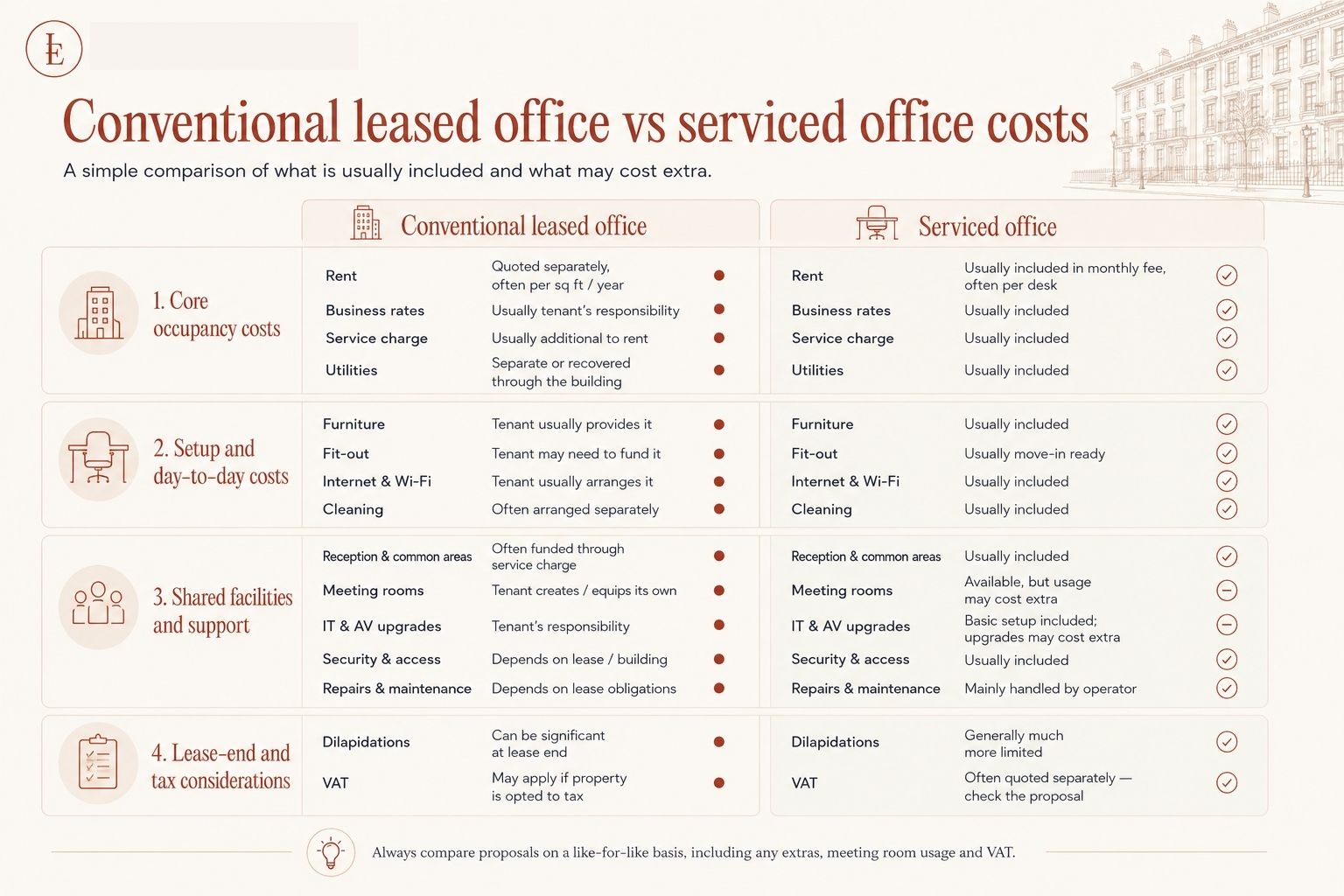
Conventional lease vs. serviced offices: Which costs are included?
In Central London, a lower quoted rent does not necessarily mean a lower overall office cost. A conventional lease gives you more control over the premises, but many expenses are paid separately, including rates, service charges, fit-out and ongoing building costs.
The condition of the space matters too, as refurbished buildings’ costs can differ considerably depending on how much work, furniture and infrastructure are already in place. Serviced offices generally bundle the core occupation costs into a single monthly fee, although extras still need checking with the individual operator.

Where to find an affordable office to rent in Central London?
An affordable Central London office is not necessarily the one with the lowest advertised rent. What matters is what you will actually pay once rates, service charges and other ongoing costs are included.
This is where having clear information from the landlord and agent makes a difference. Langham Estate and its appointed agents aim to make the process transparent, helping prospective tenants understand the space, rental terms and relevant property costs before making a commitment.
An affordable Central London office is not necessarily the one with the lowest advertised rent. What matters is what you will actually pay once rates, service charges and other ongoing costs are included.
This is where having clear information from the landlord and agent makes a difference. Langham Estate and its appointed agents aim to make the process transparent, helping prospective tenants understand the space, rental terms and relevant property costs before making a commitment.