Business rates for London offices: How much will you pay?
Rent is usually the first cost businesses consider when searching for office space in London. However, it is only one part of the total occupancy cost. Fortunately, estimating business rates for London offices is relatively straightforward once you understand three key factors: the property’s rateable value, the business rates multiplier set by the government each year, and any reliefs your business may be eligible to receive. Calculating these costs early allows businesses to compare different properties more accurately and avoid unexpected expenditure after moving in.
How are business rates for London offices calculated?
What are business rates? Business rates are a tax charged on most non-domestic properties in England, including offices, retail units, industrial premises and other commercial buildings.
Unlike rent, business rates are not negotiated with the landlord. Instead, they are calculated using a nationally determined formula based on the property’s rateable value and the applicable multiplier for that financial year. Relief schemes may then reduce the final amount payable depending on the property and the occupier’s circumstances.
Businesses can learn more about how rates are calculated using the official GOV.UK guidance on estimating business rates and by checking their property’s rateable value through the Valuation Office Agency (VOA).
For most office occupiers, estimating business rates involves three simple steps.
- Find the property’s rateable value.
- Apply the correct business rates multiplier.
- Deduct any business rates relief that applies.
This calculation provides an estimate of your annual business rates before any local adjustments or relief schemes are applied.
Step 1: Find the property’s rateable value
Every commercial property in England has a rateable value, which reflects the property’s estimated annual rental value at a specified valuation date. The rateable value is determined by the Valuation Office Agency (VOA) rather than by landlords or local councils.
It is important to understand that the rateable value is not the same as the rent you pay. Two offices with similar rents may have different rateable values depending on factors such as their size, location, specification and market evidence used during the national valuation process.
Step 2: Apply the appropriate multiplier
Once you know the rateable value, multiply it by the appropriate business rates multiplier published each financial year. Although London contains multiple local authorities, the national multipliers used across England apply to most office properties. For the 2026/27 financial year in England, the updated multipliers for standard office premises are:
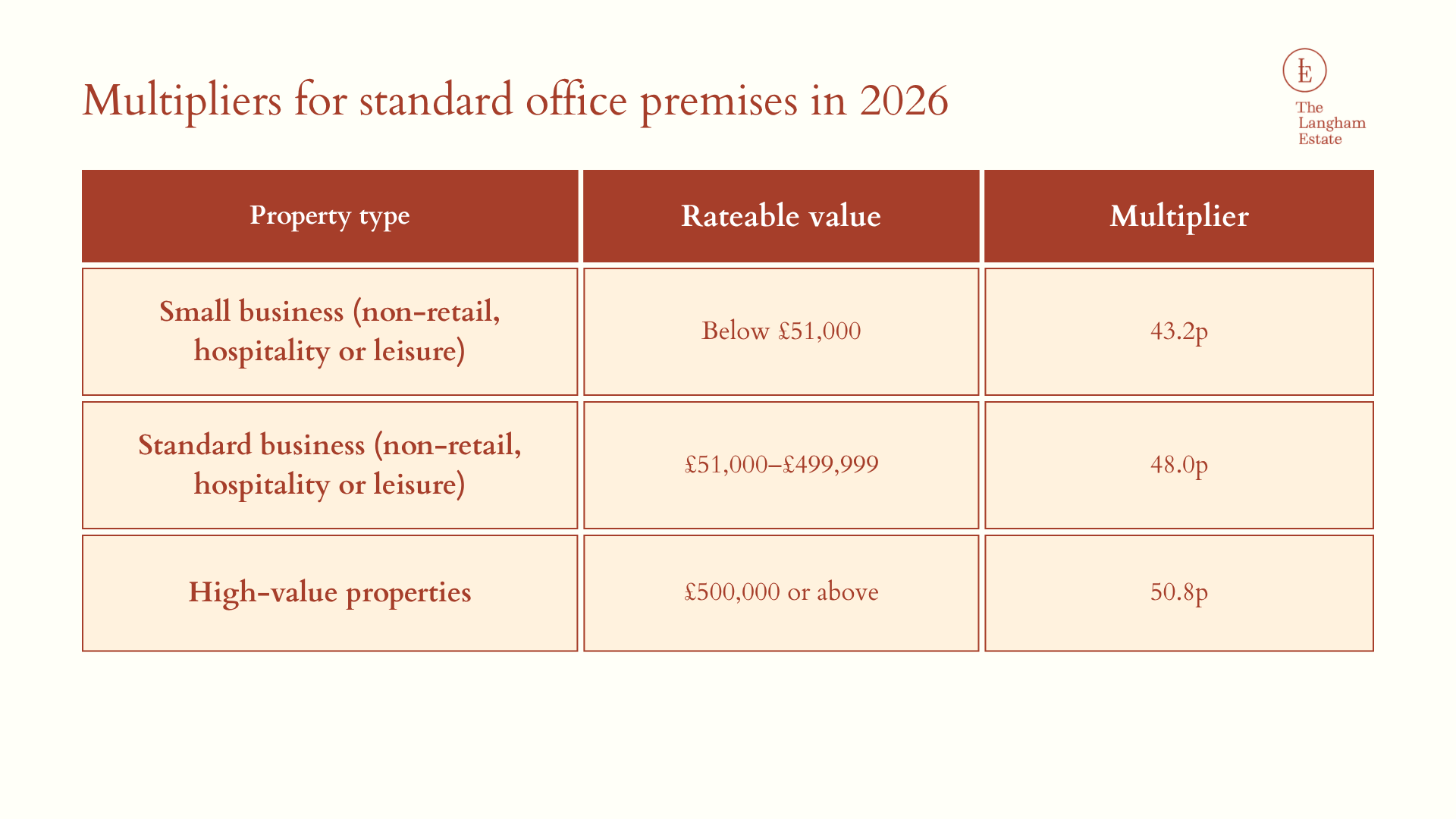
Most office occupiers will use the non-retail, hospitality and leisure multipliers, as standard office buildings do not qualify for the lower multipliers available to eligible retail, hospitality and leisure properties. Businesses occupying premises within the City of London should also be aware that additional local supplements may apply alongside the national multiplier, resulting in a higher overall rates bill compared with other London boroughs.
Step 3: Apply any available relief
The amount calculated using the multiplier represents your basic business rates liability before any reliefs are deducted.
Depending on your circumstances, you may qualify for schemes such as:
- Small Business Rate Relief
- Supporting Small Business Relief
- Transitional Relief following revaluation
- Other government-supported relief schemes where applicable
Not every office will qualify, so businesses should check eligibility before estimating their final liability.
Example: Calculating business rates for a London office
Understanding the calculation becomes much easier when using a practical example.
Imagine your business is considering an office with a rateable value of £85,000.
The property falls within the £51,000–£499,999 category, meaning the 48.0p multiplier applies.
The calculation would be:
£85,000 × 0.48 = £40,800
This gives an estimated annual business rates liability of £40,800 before any reliefs are applied.
If the business qualifies for a relief scheme, the final amount payable may be lower.
What costs should businesses budget for alongside business rates?
Business rates should never be viewed in isolation. When comparing office space, businesses should calculate the total annual occupancy cost rather than focusing solely on the base rent.
Looking at the complete financial picture makes it easier to accurately compare offices that may appear similarly priced on the surface; often, an office with slightly higher rent but lower service charges and a more efficient layout represents better long-term value than a cheaper option with high hidden running costs.
To accurately assess your overhead, consider the following typical ongoing costs, which are generally the tenant’s responsibility:
-
Rent: Not included in additional charges; tenant responsibility.
-
Business Rates: Not included in rent; tenant responsibility.
-
Service Charge: Usually not included in rent; tenant responsibility.
-
Utilities: Usually not included in rent; tenant responsibility.
-
Building Insurance Contribution: Often a separate cost; typically the tenant’s responsibility depending on the lease.
-
Fit-out and Maintenance: Costs vary based on the lease agreement; typically the tenant’s responsibility.
What business rates reliefs could office occupiers qualify for?
Not every business pays the full calculated amount. Depending on the property and business circumstances, certain relief schemes may reduce the amount payable.
Small Business Rate Relief
Businesses occupying smaller commercial properties may qualify for Small Business Rate Relief (SBRR) if they meet the eligibility criteria.
Eligibility depends on factors including:
- The property’s rateable value
- Whether the business occupies more than one property
- Other qualifying conditions
Businesses should always check the latest eligibility rules with their local council because entitlement depends on individual circumstances.
Supporting Small Business Relief
Some businesses affected by property revaluations may receive Supporting Small Business Relief, which limits how quickly business rates bills can increase following a revaluation.
This scheme helps reduce sudden financial pressure where significant increases would otherwise occur.
Transitional Relief
Where rateable values change after a national revaluation, transitional relief may gradually phase in increases or decreases rather than applying them immediately.
For businesses budgeting future occupancy costs, this can provide greater certainty during periods of valuation change.
Common mistakes businesses make when budgeting for business rates
Many businesses underestimate their total office occupancy costs because they focus almost exclusively on headline rent. While rent is often the largest expense, business rates can account for a substantial proportion of annual property costs, particularly in Central London.
Understanding these common mistakes before signing a lease can help businesses avoid budgeting surprises.
Assuming business rates are included in the rent
Unlike serviced offices, where many occupancy costs are bundled into a single monthly fee, traditional commercial leases usually separate rent from business rates.
Before agreeing to a lease, clarify exactly which costs are included. In many cases, tenants will be responsible for:
- Annual rent
- Business rates
- Service charges
- Utilities
- Building insurance contributions (where applicable)
- Internal repairs and maintenance
Looking only at the advertised rent can therefore give a misleading impression of the property’s true annual cost.
Confusing rateable value with market rent
One of the most common misunderstandings is assuming the rateable value reflects the rent paid to the landlord.
In reality, these figures serve different purposes.
- Market rent: The rent agreed between landlord and tenant in the lease
- Rateable value: An assessment made by the Valuation Office Agency (VOA) to calculate business rates
Although both are influenced by market conditions, they are not identical and should not be used interchangeably.
Forgetting that business rates can change
Some tenants assume their business rates will remain unchanged throughout the lease.
However, business rates may change due to:
- Government changes to annual multipliers
- National revaluations
- Alterations to the property
- Changes to available relief schemes
Businesses should therefore review occupancy costs periodically rather than relying on their initial estimate throughout the lease term.
Business rates in Central London: What businesses should know
Businesses looking for offices in listed buildings in Central London often encounter higher rateable values than those found in outer London or regional cities. This reflects the strength of demand, prime locations and rental values across many of London’s established commercial districts.
Areas such as Fitzrovia, Mayfair, Soho, Covent Garden and the City of London typically command higher commercial rents, which can influence a property’s rateable value. However, this should always be assessed alongside the broader advantages these locations offer.
For many businesses, a well-connected Central London office can support recruitment, strengthen brand perception and improve access to clients, partners and transport infrastructure. The objective is therefore not simply to minimise business rates, but to understand the overall value a location delivers relative to its total occupancy costs.
When comparing offices, businesses should consider:
- Total annual property costs rather than rent alone.
- Accessibility for employees and clients.
- Local amenities and business ecosystem.
- Potential for future expansion.
- The quality and flexibility of the office itself.
A higher business rates bill may be justified if the location contributes meaningfully to business growth and operational efficiency.
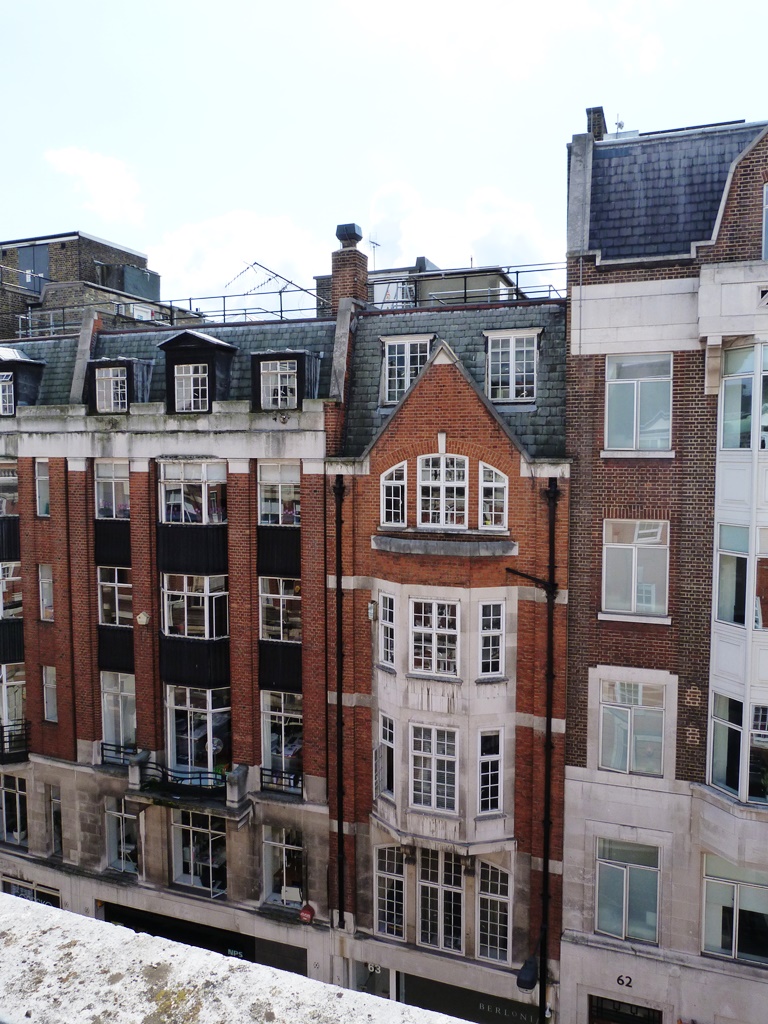
When evaluating business rates for London offices, choosing the right property is only part of the decision. Working with an experienced landlord who has a long-term commitment to the local area can also contribute to a better leasing experience.
With nearly a century of history, The Langham Estate is the current owner of a vibrant commercial neighbourhood where businesses can establish themselves and grow.
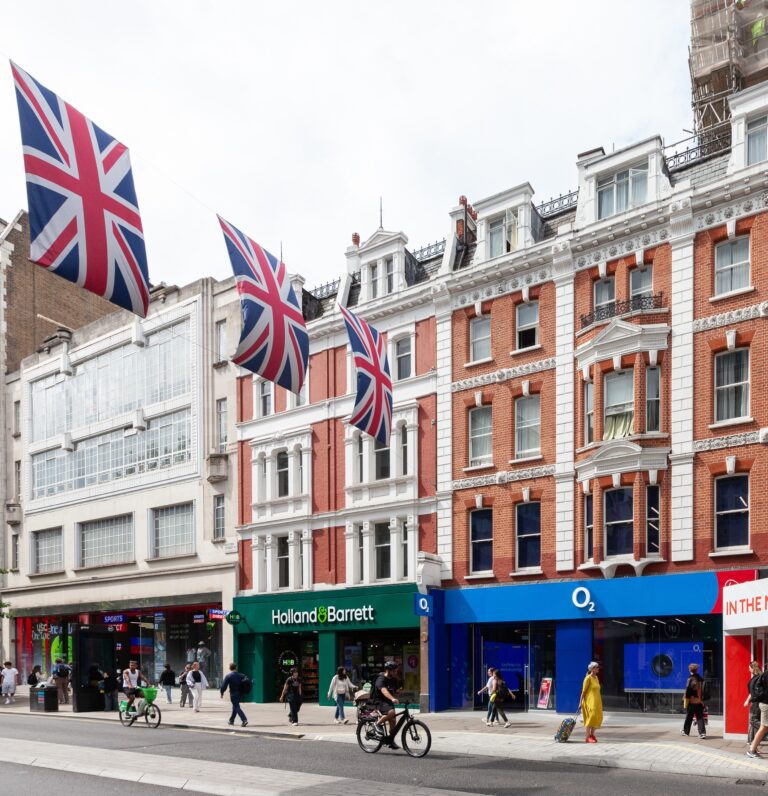
Located within the Fitzrovia Quarter, the The Langham Estate’s office and retail portfolio stretches between Oxford Street to the south and Great Portland Street station to the north, placing occupiers within one of London’s most well-connected business districts.
Conclusion
While the business rates for London offices calculation is relatively straightforward, businesses should look beyond the basic formula and consider the total cost of occupation, including rent, service charges, maintenance and any available reliefs.
For businesses considering a Central London office, evaluating location, building quality and landlord expertise alongside occupancy costs can lead to better long-term value. With a carefully managed portfolio in Central London, The Langham Estate offers office spaces that place businesses within one of London’s most connected and established commercial neighbourhoods.
While the business rates for London offices calculation is relatively straightforward, businesses should look beyond the basic formula and consider the total cost of occupation, including rent, service charges, maintenance and any available reliefs.
For businesses considering a Central London office, evaluating location, building quality and landlord expertise alongside occupancy costs can lead to better long-term value. With a carefully managed portfolio in Central London, The Langham Estate offers office spaces that place businesses within one of London’s most connected and established commercial neighbourhoods.
FAQ
Who pays business rates for a London office?
In most traditional commercial leases, the tenant is responsible for paying business rates directly or indirectly through the lease arrangements. Serviced offices may include business rates within the licence fee, so it is important to confirm what is included before signing.
How can I find the rateable value of an office?
You can search the property’s rateable value using the official Valuation Office Agency (VOA) online service. You’ll typically need the property’s postcode or address.
Are business rates the same as rent?
No. Rent is paid to the landlord for occupying the property, while business rates are a tax charged on most commercial properties. Both should be included when calculating the total cost of leasing an office.
Can business rates change during my lease?
Yes. Business rates may change following government updates to multipliers, national property revaluations or changes to the property’s rateable value.
Do all London offices qualify for business rates relief?
No. Eligibility depends on factors such as the property’s rateable value, how it is occupied and the specific relief scheme. Many office occupiers will not qualify for the lower multipliers available to eligible retail, hospitality and leisure properties.
Are business rates higher in the City of London?
The City of London applies additional local premiums that can increase the overall multiplier compared with many other London boroughs. Businesses considering offices within the Square Mile should account for these additional charges when estimating occupancy costs.